
Polish Poetry Unites is a video series for anyone interested in literature, history and reading. In each episode Edward Hirsch, a distinguished American poet, and the president of the Guggenheim Memorial Foundation, will introduce a celebrated Polish poet to American audiences.
Watch the episode on YouTube channel.
This episode of Polish Poetry Unites introduces to American audiences the life and work of Czesław Miłosz, 1980 Nobel Prize Winner.
Following the foreword by Edward Hirsch, the video showcases the Miłosz’s famous poem “Meaning” presented by Ewa Juńczyk-Ziomecka from Warsaw. The poem was translated from the Polish by Czesław Miłosz and Robert Hass.
Edward Hirsch who knew Miłosz personally says: “Czeslaw Milosz is a towering figure of not just Polish literature, but world literature. And it’s impossible to summarize him in a very short amount of time. It’s a big life, big project. I’ll just say a few things that seem to me to me about him.” (…)
Later Hirsch continues: “He first came into my consciousness when he came to the United States. He started teaching in the Slavic department at Berkeley When I was 23, I discovered his selected poems. This is the book, that was his first book that made an impact in the United States and an impact on me. The second thing was, while he was at Berkeley, he tried to cheer himself up and he wrote a history of Polish literature. This is my copy. And from this history of Polish literature, that’s how I learned everything. This was my portal. This was our portal. This is how I heard about Herbert. This is how I heard about Różewicz. This is how I heard about Szymborska. And this is how I heard about the generation before him like a poet who’s been important to me, Aleksander Wat.
Milosz’s project of explaining Polish literature was also a project of how what happened to the poet in Poland was a laboratory for what happened in Europe and what happened in the rest of the world, and he had a series of Cassandra like warnings about the ahistoricism of the United States. And he was shocked by the indifference of the US to what had happened in Europe. And he began to sound the cry, both in his own poems and in his writings about Polish literature and about literature in general. He gave a series of lectures at Harvard called The Witness of Poetry, in which he argued for poetry’s historical importance and how poetry witnessed events.
Miłosz was a poet who constantly warned about history and how we needed to learn from history, but who also wanted to transcend history, who wanted to go to, think about other things, eternal values. And this is where the wonderful poem “Meaning” comes in, that’s featured in the film, because this shows the religious quest that’s in in Milosz’s work, his longing for something beyond something that would make sense, some world beyond this world that would make sense of all the chaos, make sense of all the destruction, that something would suddenly come into order. (…)”
Czesław Miłosz, MEANING
– When I die, I will see
the lining of the world.
The other side,
beyond bird, mountain, sunset.
The true meaning, ready to be decoded.
What never added up will add up,
What was incomprehensible
will be comprehended.
– And if there is no lining
to the world?
If a thrush on a branch is not a sign,
But just a thrush on the branch?
If night and day
Make no sense following each other?
And on this earth, there is nothing
except this earth?
– Even if that is so,
there will remain
A word wakened by lips
that perish,
A tireless messenger who runs and runs
Through interstellar fields,
through the revolving galaxies,
And calls out, protests, screams.
Translated from the Polish by Czesław Miłosz and Robert Hass.
Czesław Miłosz, SENS
– Kiedy umrę, zobaczę podszewkę świata.
Drugą stronę, za ptakiem, górą i zachodem słońca.
Wzywające odczytania prawdziwe znaczenie.
Co się nie zgadzało, będzie się zgadzało.
Co było niepojęte, będzie pojęte.
– A jeżeli nie ma podszewki świata?
Jeżeli drozd na gałęzi nie jest wcale znakiem
Tylko drozdem na gałęzi, jeżeli dzień i noc
Następują po sobie nie dbając o sens
I nie ma nic na tej ziemi, prócz tej ziemi?
– Gdyby tak było, to jednak zostanie
Słowo raz obudzone przez nietrwałe usta,
Które biegnie i biegnie, poseł niestrudzony,
Na międzygwiezdne pola, w kołowrót galaktyk
I protestuje, woła, krzyczy.
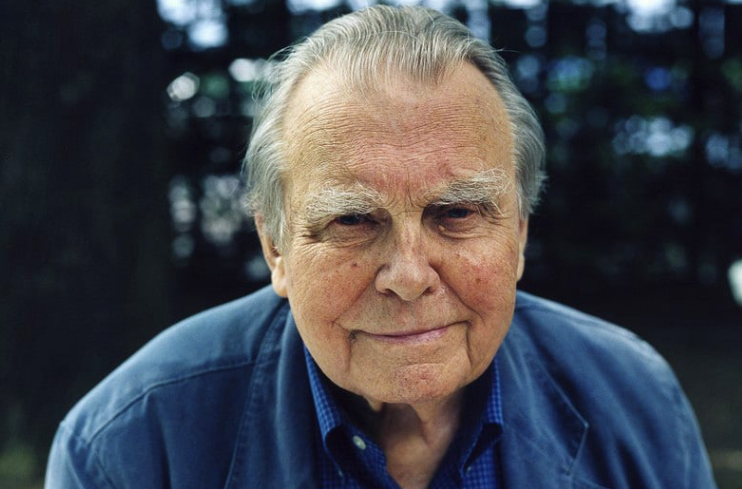
Czesław Miłosz (born June 30, 1911, Šeteniai, Lithuania, Russian Empire [now in Lithuania]—died August 14, 2004, Kraków, Poland) was a Polish American poet, novelist, translator, critic, and diplomat who received the Nobel Prize for Literature in 1980. He was cited then as a writer “who with uncompromising clear-sightedness voices man’s exposed condition in a world of severe conflicts.” Miłosz’s writing examines the impact of repressive regimes and systems such as national socialism and communism on the human spirit. He was foremost a poet, but his best-known work is the essay collection The Captive Mind (1953).
The son of a civil engineer, Miłosz completed his university studies in Wilno (now Vilnius, Lithuania), which belonged to Poland between the two World Wars. His first book of verse, Poemat o czasie zastygłym (1933; “Poem of Frozen Time”), expresses catastrophic fears of an impending war and worldwide disaster. During the Nazi occupation he moved to Warsaw, where he was active in the resistance and edited Pieśń niepodległa: poezja polska czasu wojny (1942; “Independent Song: Polish Wartime Poetry”), a clandestine anthology of well-known contemporary poems.
Miłosz’s collection Ocalenie (1945; “Rescue”) contains his prewar poems and those written during the occupation. In the same year, he joined the Polish diplomatic service and was sent, after briefly working during 1946 in the Polish embassy in New York City, to Washington, D.C., as cultural attaché, and then to Paris, as first secretary for cultural affairs in Paris. There he asked for political asylum in 1951. Nine years later he immigrated to the United States, where he joined the faculty of the University of California at Berkeley and taught Slavic languages and literature until his retirement in 1980. Miłosz became a naturalized citizen of the United States in 1970.
Until 1980, when Miłosz was awarded the Nobel Prize for Literature, his work was banned in Poland because of his defiance of the country’s communist government. Yet he was widely admired there, and many underground editions of his poetry collections were printed. His winning the Nobel Prize led the Polish government to authorize an anthology of his poems, which sold a remarkable 200,000 copies.
There are several volumes of English translations of Miłosz’s poetry, including The Collected Poems 1931–1987 (1988) and Provinces (1991). His prose works include his autobiography, Rodzinna Europa (1959; Native Realm), Prywatne obowiązki (1972; “Private Obligations”), the novel Dolina Issy (1955; The Issa Valley), and The History of Polish Literature (1969).
Though Miłosz was primarily a poet, his best-known work became his collection of essays Zniewolony umysł (1953; The Captive Mind), in which he condemns the accommodation of many Polish intellectuals to communism. This theme is also present in his novel Zdobycie władzy (1955; The Seizure of Power). His poetic works are noted for their classical style and their preoccupation with philosophical and political issues. An important example is Traktat poetycki (1957; Treatise on Poetry), which combines a defense of poetry with a history of Poland from 1918 to the 1950s. The critic Helen Vendler wrote that this long poem seemed to her “the most comprehensive and moving poem” of the latter half of the 20th century.
In 2001 Miłosz published To Begin Where I Am, a collection of autobiographical essays, and New and Collected Poems: 1931–2001. Both books contain English translations of new and earlier pieces. Many other collections appeared after his death in 2004. Some of his earlier poems were translated into English in Poet in the New World (2025), edited by Robert Hass and David Frick.
(Source – Britannica)
The POLISH POETRY UNITES episode about Czesław Miłosz was produced with additional support from: the Museum of Literature in Warsaw and New York Women in Film & Television
Lead image: Czesław Miłosz, fot. SIPA / East News
Bio image: Czesław Miłosz, fot. AKG Images / East News
Moderator: Edward Hirsch
Writer and Director: Ewa Zadrzyńska
Curator and Executive Producer: Bartek Remisko