
Tuesday, November 17, 2026, 7:00 PM
e-flux
172 Classon Ave, Brooklyn NY 11205
Tickets: General $12 Student $10
Join us at e-flux on Tuesday, November 17 at 7pm for “Theory of Seeing,” a four-part film series translating Władysław Strzemiński’s Theory of Seeing (1958; republished in English by e-flux Classics in 2025) to the language of moving images through new films by Wilhelm Sasnal, Mykola Ridnyi, Agnieszka Polska, and Anton Vidokle and Liam Gillick, with title sequences by Laura Pawela. The screening will be followed by a response from R.H. Quaytman. Commissioned by Muzeum Sztuki, the project does not aim merely to illustrate Strzemiński’s theses, but to put them into practice under the premise that seeing is not an unchangeable ability, but a process shaped by history and the social conditions of life. Each era creates its own unique ways of seeing, and art participates in these transformations.
Translating Theory of Seeing into film demands more than simply presenting the notions contained within it. Film is not a transparent medium, but an apparatus that organizes the act of seeing through framing, editing, movement, light, and time. It is therefore a tool through which Strzemiński’s ideas can be put to a practical test, demonstrating how a picture emerges at the intersection of the eye, memory, knowledge and experience. Each episode becomes an experiment, which does not so much explain the theory as set it in motion.
Each episode offers an original contemporary interpretation of Strzemiński’s thought. Wilhelm Sasnal connects museum conservation and the materiality of a picture with the memory of the Holocaust, asking about the limits of abstraction in relation to historical experience. Mykola Ridnyj confronts the theory of moving vision with the optics of war, relating it to the history of Strzemiński’s physical impairment and a fictional story about a sniper. Agnieszka Polska transposes his insights into the cybernetic context, the attention economy, and images generated by artificial intelligence. Anton Vidokle and Liam Gillick treat the book’s theses as a series of exercises performed by an actor, a camera, and a city. The series is held together by titular sequences created by Laura Pawela using found footage.
The series joins a constellation that has been taking shape over several decades and includes Strzemiński’s book, the historical space of the Neoplastic Room, the Muzeum Sztuki in Łódź’s permanent collection display Ways of Seeing, and contemporary interpretations formulated through film. It will be complemented by a website dedicated to the book and the series, prepared in collaboration with e-flux and featuring source materials as well as new texts by Luiza Nader and Elena Vogman.
Each element serves a different function: the book articulates a theory of transformations in visual consciousness, the films put its concepts to a contemporary test, the exhibitions allow them to be examined through a physical encounter with artworks in the museum space, and the website opens up a field for further research and interpretation. The elements of the constellation do not form a linear sequence, but explain and update one another. Theory of Seeing
thus becomes not a closed treatise, but a still-active tool and a script for experiments in how we see and in what we have yet to learn how to see.
Films
Liam Gillick and Anton Vidokle, Theory of Vision (2026, 18 minutes)
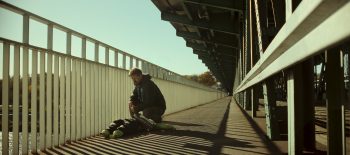
In Liam Gillick and Anton Vidokle’s film, the actor’s body becomes entangled in visual structures inspired by Strzemiński’s Theory of Seeing, yet found in the urban spaces of Łódź. The protagonist—a porte-parole for Strzemiński, or perhaps an abstract viewing subject—moves among planes, axes, lines, and grids, reciting passages on realism from the book. Is he performing a rehearsed role? Or are we watching the making of a theory—hesitation, questioning, searching for the right words? A film that is at once hypnotic and formally rigorous.
Mykola Ridnyi, Grey Zone (2026, 18 minutes)
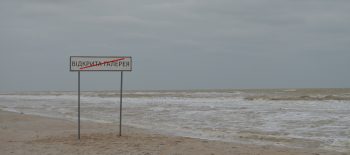
“This is a film about the conflict between two identities—the artist and the soldier,” says Mykola Ridnyi. In Grey Zone, he evokes a biographical context absent from Strzemiński’s theory: the experience of a soldier and military engineer who suffered an eye injury during the First World War. The film centres on a sniper and his perspective, mediated by a rifle scope. Ridnyi returns to questions explored in his earlier work: How do advances in viewing technologies shape contemporary warfare?
Wilhelm Sasnal, Cow, Pig, Flax (2026, 17 minutes)
Wilhelm Sasnal’s film holds a multilayered polemic with Strzemiński’s Theory of Seeing. It is sensuous, free, corporeal. It counters abstraction with the concrete, intellect with the senses, and discourse with fairy tale. Drawing on motifs from a tale by Hans Christian Andersen, Sasnal asks: What if the landscape looks at us, just as we look at it? “I wanted to put everything on an equal footing,” says Sasnal. “It is not only humans who look—everything looks at everyone.”
Agnieszka Polska, The Birth of a Prediction Machine (2026, 20 minutes)
“What happens when our internal model of reality loses all credibility?”, Agnieszka Polska asks. Her collage film essay broadens Strzemiński’s thinking to encompass contemporary neuroscience and images generated by artificial intelligence. A child is born. What does he see? What will he see? In Polska’s view, the contemporary iconosphere has become a space of radical uncertainty, colonized by corporations, capital and algorithms designed to exploit the brain’s reward system.
ABOUT THE ARTIST
Anton Vidokle is an artist and Founding Director of e-flux.
Liam Gillick is a New York based artist known for contributions in sculpture, video, architecture, and text. His work focuses on contemporary management of labor, time, and aesthetics extended through a distinctive conception of exhibition as a medium in its own right. His work is divided between abstraction based on social and political structures of the present and texts, films, and graphics that often appear to contradict and comment upon the apparent clarity of his structures. Gillick’s work has been included in numerous important exhibitions including documenta and the Venice, Berlin, Shanghai and Istanbul Biennales — representing Germany in 2009 in Venice. Solo museum exhibitions have taken place at the Museum of Contemporary Art in Chicago, the Museum of Modern Art in New York and Tate in London.
Mykola Ridnyi was born in Kharkiv, Ukraine. He lives and works in Berlin where he holds a guest professorship in the multimedia art class at the Berlin University of the Arts. In recent films, video installations, and photography cycles, he experiments with nonlinear montage and a collage of documentary and fiction. He works with reenactment, often based on research in Ukrainian and European politics, history, and cinema. Ridnyi reflects on social and political reality and shows the contrast between the fragility and resilience of individual and collective histories. The body of his work created within the last decade addresses the question of how to talk about violence and war without multiplying its brutality in visual language. His works have been presented internationally at various institutions and festivals, including the Manifesta 16 Ruhr (2026), The Kyiv Biennial (2024, 2017, 2015), the Kochi Biennial (2022), the 56th Venice Biennale (2015) among the others.
Wilhelm Sasnal (b.1972, Tarnów, Poland ) studied architecture at the Polytechnic in Kraków, beginning in 1992, and later continued his studies at the Academy of Fine Arts, also in Kraków, where he received his diploma from the Department of Painting in 1999. Sasnal often starts his paintings with photographic images taken from films, art reproductions, popular culture, or his own phone, then transforms them through various degrees of distortion, reduction, and abstraction. His work addresses subjects ranging from the seriousness of historical events like the Holocaust to recognizable icons of popular culture, as well as the people, including his family, places, and everyday objects around him. His paintings often depend on the local milieu — echoing the quotidian of his home in Poland or the vibrant surroundings of his studio in California.
Agnieszka Polska (b. 1985, Lublin, Poland) is a visual artist, film and theatre director based in Berlin. Polska employs computer-generated media to explore themes of individual agency, social responsibility, and the shaping of historical narratives within environments driven by rapid technological changes and the flow of information. Her work bridges the past and the digital present, using hallucinatory animations and poetic storytelling to delve into the ethical ambiguities of contemporary society. Polska’s art has been showcased internationally, including exhibitions at the New Museum and MoMA in New York, Centre Pompidou in Paris, Tate Modern in London, and the Hirshhorn Museum in Washington, D.C. She has held solo exhibitions at Hamburger Bahnhof in Berlin, the Museum of Modern Art in Warsaw, M HKA in Antwerp, Frye Art Museum in Seattle, Nottingham Contemporary, and Salzburger Kunstverein. She participated in the 57th Venice Biennale, 11th Gwangju Biennale, 19th and 24th Biennale of Sydney, 14th Shanghai Biennale, and 13th Istanbul Biennial. In 2023, she premiered her first theatre play, The Talking Car, in the frame of BoCA Biennale, Lisbon.
R. H. Quaytman (b. 1961, Boston) lives and works in Guilford, CT and New York. Quaytman studied at Bard College and at the Institut des Hautes Études en Arts Plastiques in Paris, and received the Rome Prize Fellowship from the American Academy in 2001. In 2005, she co-founded Orchard, a cooperatively-run exhibition and event space that concluded its three-year run on the Lower East Side in 2008. Quaytman’s work was featured in the 15th Shanghai Biennale (2025), documenta 14 (2017), the 54th Venice Biennale (2011) and the 2010 Whitney Biennial. Recent solo exhibitions of her work have taken place at Glenstone, Potomac, MD (2022), WIELS, Brussels (2021), a two-part exhibition at the Serralves Museum, Porto (2020) and Muzeum Sztuki, Lódz (2019), Museum Brandhorst, Munich (2019), Solomon R. Guggenheim Museum, New York (2018), Galerie Buchholz, Berlin and Cologne (2018, 2011), Secession, Vienna (2017), the Museum of Contemporary Art, Los Angeles (2016), Miguel Abreu Gallery, New York (2025, 2015, 2008), Tel Aviv Museum of Art (2015), Gladstone Gallery, New York and Brussels (2014, 2012), Renaissance Society, Chicago (2013), the Museum Abteiberg, Mönchengladbach (2012), the Kunsthalle Basel (2011), the San Francisco Museum of Modern Art (2010), and the Institute of Contemporary Art, Boston (2009), among others.
Laura Pawela is a Polish visual and video artist, sculptor, film editor and lecturer at Lodz Film School. Born in 1977 in Upper Silesia, she lives and works in Warsaw, Poland. Pawela graduated from Academy of Fine Arts in Wroclaw (2004, Sculpture). She recently defended her PhD in art in Lodz Film School, where she conduct classes in video art and found footage films. She is a member of both Polish and European Film Academy.
Co-financed by the Ministry of Culture and National Heritage of the Republic of Poland as part of the Inspiring Culture 2025–2026 program, within the framework of the project Theory of Seeing, implemented in cooperation with e-flux and the Polish Cultural Institute New York.
Lead image: Agnieszka Polska, The Birth of a Prediction Machine (still), 2026.