
Cyprian Kamil Norwid with George G. Grabowicz – Encounters with Polish and Ukrainian Literature
S6E6 and all video recordings are available on our YouTube.
Encounters with Polish and Ukrainian Literature is a video series for anyone interested in literature and the culture of books and reading. Each month, host David A. Goldfarb will present a new topic in conversation with an expert on that author or book or movement in Polish literature. More about the Encounters with Polish and Ukrainian Literature series and the timeline.
Cyprian Kamil Norwid (1821-83) was born in the village of Głuchy north of Warsaw to a family of minor nobility, but both of his parents died when he was young, and his upbringing was further complicated by the November Uprising of 1830, but he studied the visual arts and was able to make a modest living as a graphic artist and sculptor, living abroad for most of his life in Italy, Berlin, New York, London, and primarily Paris. He maintained connections with the major cultural figures of the Polish emigration, including Mickiewicz, Słowacki, Chopin, Krasiński. He was critical of the Messianism and nationalism of the earlier Romantics, but was a devoted Catholic and was dedicated to the advancement of society toward greater freedom and sympathized with the American abolitionist movement. Norwid avoided the trend toward greater uniformity of versification, exemplified by Bohdan Zaleski and Wincenty Pol, often composing free verse, and experimenting with neologisms, irony, and subtle metaphor. He saw the artist as being in dialogue with the people in their labor. The folk could be the source of art, but the artist could draw on these sources to “organize the national imagination” (tr. Czesław Miłosz) through high art, “raising the inspirations of simple folk to a power which touches to the core and encompasses all of humanity” (tr. Manfred Kridl).
In this episode we discuss Norwid’s background and context in relation to Romanticism, and how he rose to prominence only after his death, thanks to the interest of the Modernists associated with the artistic movement known as “Young Poland” (Młoda Polska), especially Zenon Przesmycki (“Miriam”), editor of the influential journal Chimera. We look closely at a few poems that unlock some of Norwid’s major ideas—the introduction to Vade Mecum (1858), “To Citizen John Brown” (1859), and “The Native Language” (1865)—and explore some of the challenges in reading and translating his poetry.
Cyprian Kamil Norwid in English translation:
Norwid, Cyprian Kamil. Poems. Tr. Danuta Borchardt. Brooklyn: Archipelago Books, 2011.
Norwid, Cyprian Kamil. Poems – Letters – Drawings. Ed. and tr. Jerzy Peterkiewicz with Christine Brooke-Rose and Burns Singer. Manchester: Carcanet, 2000. (Best sourced from a research library or through interlibrary loan).
Norwid, Cyprian Kamil. Selected Poems. Tr. Adam Czerniawski. London: Anvil Press, 2004.
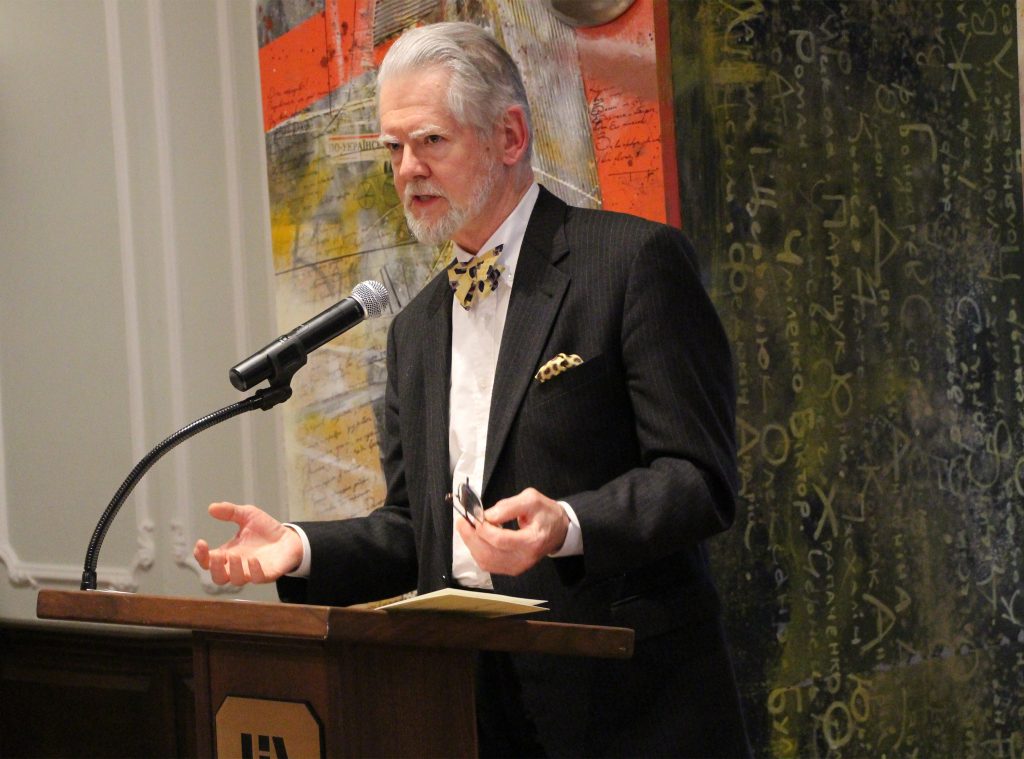
George G. Grabowicz is the Dmytro Čyževs’kyj Research Professor of Ukrainian Literature in the Department of Slavic Languages and Literatures at Harvard University. He received his B.A. from Yale University (1965) and his PhD in comparative literature from Harvard (1975), where he was also Junior Fellow in the Society of Fellows (1971-1974).
Professor Grabowicz has been Chairman of the Department of Slavic Languages and Literatures at Harvard (1983-1988) and Director of Harvard’s Ukrainian Research Institute (1989-1996). He was one of the founders and President (1991-1993) of the International Association for Ukrainian Studies and Chairman of the American Committee of Slavists (1983-1988). From 2012 to 2018 he was President of the Shevchenko Scientific Society in the US and is currently a Vice-President there.
In 1997 he founded and since then has been editor-in-chief of the Ukrainian monthly Krytyka, a leading intellectual journal in Ukraine. Since 2000 the publishing house of Krytyka has produced some one hundred and fifty books, particularly academic books in the humanities, many of them published jointly with Harvard’s Ukrainian Research Institute, the Shevchenko Scientific Society in the US and the Ukrainian Academy of Arts and Sciences in the US.
Professor Grabowicz has written on Ukrainian, Polish and Russian literature and on literary theory. His first book on Shevchenko (The Poet as Mythmaker, 1982; Ukrainian editions: 1991 and 1997) has been voted the most influential academic book of the post-Soviet period in Ukraine. His most recent publication is the two volume Тарас Шевченко в критиці [Taras Shevchenko: The Critical Reception], Kyiv, Krytyka, 2013 and 2016. He currently heads an international team of scholars working on a history of Ukrainian literature that is due to appear in 2023. A full bibliography of his writings (up to 2015) is available online. In March 2022 he was awarded the Shevchenko Prize, Ukraine’s highest award in the humanities and arts, for his series of articles on modernism and the poet Pavlo Tychyna.
David A. Goldfarb, Host & Producer
Bartek Remisko, Curator and Executive Producer
Natalia Iyudin, Produce
Image:
Cyprian_Kamil_Norwid, foto Michał Szwejcer, 4 Jan 1871, photo credit © public domain, photo by Michał Szwejcer, 4 Jan. 1871
Image courtesy of © George G. Grabowicz