
Bolesław Prus – Encounters with Polish and Ukrainian Literature
S5E8 and all video recordings are available on our YouTube.
Encounters with Polish and Ukrainian Literature is a video series for anyone interested in literature and the culture of books and reading. Each month, host David A. Goldfarb will present a new topic in conversation with an expert on that author or book or movement in Polish literature. More about the Encounters with Polish and Ukrainian Literature series and the timeline.
Bolesław Prus (Aleksander Głowacki, 1847-1912), like Charles Dickens in English, is one of the most beloved Polish realist novelists of the nineteenth century. Writers who may seem radically different from Prus, such as Dorota Masłowska and Olga Tokarczuk have listed Prus among their favorite Polish writers for his vivid characters and transparent descriptive language.
Prus’s most popular novel, The Doll (Lalka) is the subject of a film project under the direction of Maciej Kawalski and a Netflix series directed by Paweł Maślona currently in 2025 and was made into a film directed by Wojciech Has in 1968 as well as a television series directed by Ryszard Ber in 1977. His historical novel Pharoah appeared in a new English translation by Christopher Kasparek in 2024. The Doll is one of the great realist novels of the nineteenth century, addressing many of the characteristic issues of the genre—a man (Stanisław Wokulski, a merchant) in possession of a fortune in want of a wife, the relation of the rising middle class to the declining gentry, the objectivism of the late nineteenth century in comparison to the Romantic idealism of the older generation, and the political problem of being in Central Europe between much more powerful neighbors during the time of the Polish partitions. It is also one of the great novels of Warsaw, describing streets and scenes that can still be seen today even after the destruction of World War II and postwar reconstruction of the capital city.
A work such as this calls for new readings in every era, so it is no surprise that there should be two new film projects based on the text now, when, for instance, Polish filmmakers can draw attention to elements of the novel that may be perceived as critical of Russia, which was not possible during the Soviet period or even during Prus’s era, as we know from a censored passage from the novel that is published alongside contemporary editions, including the English translation. Maślona has been criticized for taking more of a feminist approach—though the final film has not even appeared yet—and there is plenty of material in the novel do develop a reading that focuses on the plight of the heroine, Izabela Łęcka, and of women in nineteenth-century European society more generally.
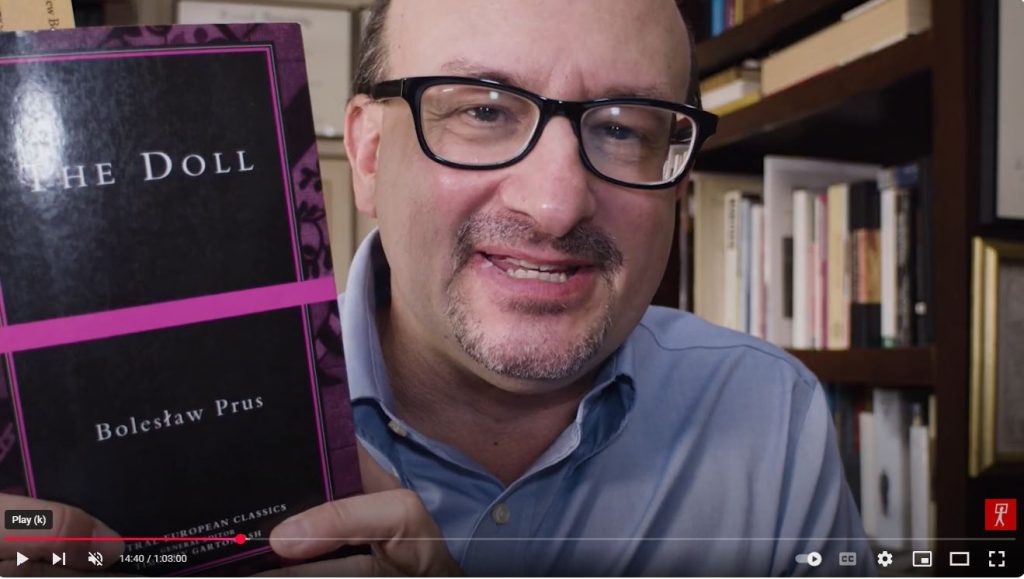
In this episode David Goldfarb, our host, uses Prus’s novel, The Doll, to address the crisis in literacy discussed in the media recently, in reaction to the use of AI in the classroom, and in light of the effects of the COVID pandemic on reading practices. Building on his own pre-pandemic experience of teaching his course on the Polish Novel at Barnard College, Columbia University, he offers some suggestions for how to read a big novel like The Doll, as a scholar, critic, or student, and applies some of those techniques to the opening chapters and other selected passages of the novel.
Selected works of Bolesław Prus in English Translation:
Prus, Bolesław. “Apparitions.” In Warsaw Tales. Selected and tr. Antonia Lloyd-Jones. Ed. Helen Constantine. Oxford: Oxford University Press, 2024. Pgs. 1-13.
Prus, Bolesław. The Doll. Tr. David Welsh and revised by Dariusz Tołczyk and Anna Zaranko. Introduction by Stanisław Barańczak. New York: NYRB Classics, 2011. (This edition is identical to the 1996 edition from CEU Press, including Barańczak’s introduction).
Prus, Bolesław. Emancipated Women. Tr. Stephanie Kraft. Amherst, Mass.: Levellers Press, 2015.
Prus, Bolesław. Pharoah. Tr. Christopher Kasparek. New York: Hippocrene Books, 2024.
Prus, Bolesław. “The Sins of Childhood” & Other Stories. Tr. Bill Johnston. Evanston, Ill.: Northwestern University Press, 1996.
David A. Goldfarb, Host & Producer
Bartek Remisko, Curator and Executive Producer
Natalia Iyudin, Producer
Lead image: Sofia Andrukhovych, Image courtesy of Sofia Andrukhovych
Guest photo: Vitaly Chernetsky, Image courtesy of Vitaly Chernetsky