
Polish Poetry Unites is a video series for anyone interested in literature, history and reading. In each episode Edward Hirsch, a distinguished American poet, and the president of the Guggenheim Memorial Foundation, will introduce a celebrated Polish poet to American audiences.
Watch the episode on YouTube channel.
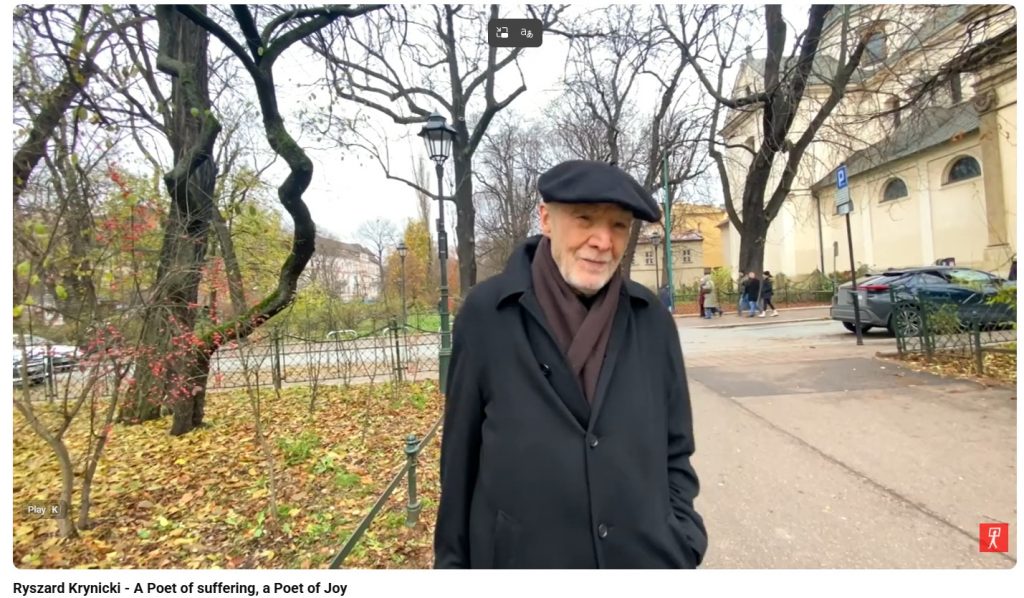
This episode of Polish Poetry Unites introduces Ryszard Krynicki to American audiences.
On June 28 2026 the poet will celebrate his 83rd birthday.
Following the foreword by Edward Hirsch, the video features three poems selected and read by the poet himself. Two of the poems were translated from Polish by Joanna T. Huss and one by Claire Cavanagh.
“Ryszard Krynicki is a poet, a translator, an editor, and a publisher,” says Edward Hirsch in his foreword – “He is one of the true people of letters in Polish literature. He’s also one of the last true living heirs to Zbigniew Herbert.”
Not much will remain, Ryszard, really not much of the poetry of this insane century Herbert writes in the To Richard Krynicki – a Letter: ”certainly Rilke, Eliot, and a few other distinguished shamans who knew the secret of conjuring a form with words that resist the action of time, without which no phrase is worth remembering and speeches like sand.
Krynicki’s has taken Herbert’s challenge and written a poetry of high seriousness. His poems are very short and feel as if they’re engraved in stone.
The American poet Louise Bogan said about Marianne Moore, that “her poetry is compactness compacted”. And that’s true of Krynicki’s work”, Edward Hirsch continues. He’s translated Paul Celan, and he is perhaps the poet closest to Celan in sensibility, linguistic originality, and elusiveness.
These three poems that Ryszard is reading in the film are very characteristic of his work. They’re travel poems, one in London, one in Paris, one at home in Krakow. But beneath these travel poems, you notice that two of them are, in a sense, poems of the road. What he highlights is the suffering of a single individual, a refugee or a homeless person whom he finds on a grate, on the street, or lying on a cardboard box. And underneath the moments he finds, moments in time that seem to exist outside time, is his focus on suffering.
And then, in the Krakow poem, as he walks through the city, he highlights a small detail, almost as if he were writing a Japanese poem: a red squirrel scampering about. But this squirrel gives him a moment of tremendous joy.
And what I like about these three poems is that they reflect the deepest aspect of Krynicki’s work, which is that he’s a poet of suffering, but he’s also a poet of joy.
I was here
A flash — a fading hieroglyph of light on the wall — and the helpless charm, repeated stubbornly, “Kilroy was here,” like carvings on rock. In the niche of dusk, a homeless man lays out his cardboard for the night.
No one is reflected in the wall.
Translated from the Polish by Joanna Huss
Byłem tutaj
Błysk, gasnący hieroglif promienia na murze –
i powtarzane z uporem bezradne zaklęcie
„Kilroy was here” jak naskalne
ryty. We wnęce zmroku bezdomny
rozkłada swoje kartony na nocleg.
Nikt
odbija się w ścianie.
Rue de Poitiers
Late afternoon, light snow.
The Musee d’Orsay’s on strike, nearby
a gray lump bundled on the sidewalk’s edge:
a bum curled in a ball (maybe a refugee
from some country caught in civil war)
still lying on the grate, packed in a quilt,
a scrap-heap sleeping bag, the right to life.
Yesterday his radio was playing.
Today coins cooling on a paper shape constellation,
nonexistent moons and planets.
Translated from the Polish by Clare Cavanagh
Rue de Poitiers
Późne popołudnie, prószy śnieg.
Nieopodal strajkującego Musée d’Orsay
widać szary tobołek na skraju chodnika:
zwinięty w kłębek kloszard (albo uciekinier
z jakiegoś ogarniętego wojną domową kraju)
nadal leży na kracie, okutany w koce,
śpiwór z odzysku i prawo do życia.
Wczoraj miał jeszcze włączony tranzystor.
Dziś stygnące monety układają się na gazecie
w konstelacje niebyłych planet i księżyców.
Untitled
Returning home, I saw a little red squirrel
running across the street.
It darted away from a car
and swiftly climbed an ash tree by the park.
What better thing
could have happened to me today?
Translated from the Polish by Joanna Huss
Bez tytułu
Wracając do domu zobaczyłem małą rudą wiewiórkę
Przebiegającą przez ulicę
umknęła przed samochodem
I błyskawicznie wspięła się na jesion, przy parku
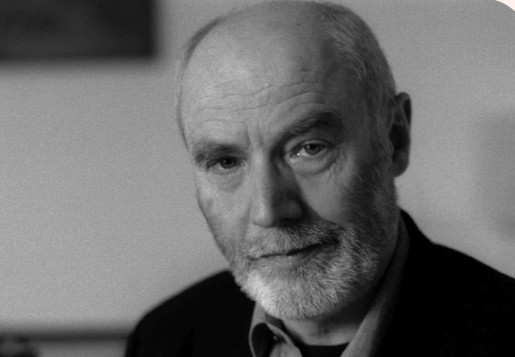
Ryszard Krynicki, one of Poland’s most important contemporary poets, was born in a labor camp in Sankt Valentin (Lower Austria) in 1943. Since the 1960s, when he became known as one of the poets of the New Wave, Krynicki has been associated with the democratic opposition in Poland. As a result, he was subjected to censorship and then banned completely from official publication between 1976 and 1980, although he continued to publish with unofficial presses and, in the case of Our Life Grows (1978), with the Paris émigré press Kultura. After working for years as an editor in underground publishing and running a private art gallery with his wife, Krystyna, in their Poznań apartment, he founded the influential publishing house a5 in 1988; from the start, the press focused on contemporary Polish poetry, including the works of Wisława Szymborska, Adam Zagajewski, and many younger poets. Krynicki is also renowned as a translator of German-language poets, including Nelly Sachs and Paul Celan. A recipient of many prestigious literary awards, he was most recently awarded the Zbigniew Herbert International Poetry Prize in 2015. He lives in Kraków.
(Source: The NYRB)
This episode of Polish Poetry Unites introduces Ryszard Krynicki to American audiences was produced with additional support from: the Museum of Literature in Warsaw and New York Women in Film & Television
Lead image: Ryszard Krynicki, photo courtesy of Ryszard Krynicki
Bio image: Ryszard Krynicki, photo by Elżbieta Lempp
Moderator: Edward Hirsch
Writer and Director: Ewa Zadrzyńska
Curator and Executive Producer: Bartek Remisko