
Playwrights 1 — Fredro, Wyspiański, and Przybyszewski – Encounters with Polish and Ukrainian Literature
S6E7 and all video recordings are available on our YouTube.
Encounters with Polish and Ukrainian Literature is a video series for anyone interested in literature and the culture of books and reading. Each month, host David A. Goldfarb will present a new topic in conversation with an expert on that author or book or movement in Polish literature. More about the Encounters with Polish and Ukrainian Literature series and the timeline.
This episode marks the beginning of a new mini-series within “Encounters with Polish and Ukrainian Literature” focusing on drama and playwrights. As a way into this topic, we are going to look at three plays structured around the marriage plot.
Aleksander Fredro (1793-1876) is often associated with the Romantics, because he lived and wrote comedies for the stage during the era of Romanticism, but he was really an anti-Romantic closer to Enlightenment or even Baroque playwrights like Molière, Goldoni, or Beaumarchais than to his contemporaries, Mickiewicz and Słowacki. He was a member of the szlachta or Polish gentry, who fought under Napoleon and traveled extensively, but did not emigrate like the more well-known Polish writers of his era. His travels exposed him to the European theater and commedia dell’arte, but he had resources and no reason to leave his home country.
Stanisław Wyspiański (1869-1907), the son of a sculptor, was a dramatist, writer, and painter and one of the co-founders of the modernist movement known as “Młoda Polska” or “Young Poland” at the turn of the nineteenth and twentieth centuries. As a multimedia artist, he was a theatrical maximalist conceiving of monumental works in the mode of the Polish Romantics and Wagner’s Gesamtkunstwerk, the “total work of art” encompassing the language and action of drama along with music; the visual aspects of set design, costumes, and lighting; reality, myth, and folklore; and blurring the line between the theater and the outside world. Wyspiański is often regarded as the founder of the modern Polish theater.
Stanisław Przybyszewski (1868-1927) was an expressionist novelist, essayist, poet, and dramatist, very popular in his day, publishing in Russian and German as well as Polish, and translated into English in his own time. His idea of the “naked soul”—the essential kernel of personal identity—would figure in important ways into the thought of many thinkers and avantgarde prose writers of the 1930s, and he brought eroticism to the surface in ways that would also become important during the interwar period of free Poland. He was close to painter, Edward Munch and even claimed to have proposed the title for Munch’s most famous painting, “The Scream” and was involved in a love triangle with Munch and poet and translator Dagny Juel, whom he married.
In this episode we look at Fredro’s Maidens’ Vows: Or the Magnetism of the Heart as the classical wedding play, in which all the right people get married, and the marriage solves the problems of the work, which reflect the problems of society. Wyspiański’s The Wedding is a work that combines fantastical elements from folklore with an actual wedding attended by the author, and embodies central themes in Polish culture such as the division between the peasants and the nobles or alternately the country and the city, which must be resolved in order to resurrect the nation in the time of the partitions. Przybyszewski’s Snow mirrors the structure of Fredro’s work at first but takes some bizarre turns with the formation of unexpected love triangles and ends in tragedy rather than resolution.
Fredro, Wyspiański, and Przybyszewski, selected dramas in English translation:
Alexander Fredro. The Major Comedies of Alexander Fredro. Tr. with intro. and commentary by Harold B. Segel. Princeton, N.J.: Princeton University Press, 1969.
Stanisław Przybyszewski. Snow. Tr. O.F. Theis. New York: Nicholas L. Brown, 1920.
Stanisław Wyspiański. Meleager: A Tragedy. Tr. Florence and George Rapall Noyes. Berkeley, Cal.: University of California Press, 1933. (Check your local research or university library or try interlibrary loan)
Stanisław Wyspiański. The Wedding. Tr. Noel Clark. Intro. by Jerzy Peterkiewicz. London: Oberon Books, 1998.
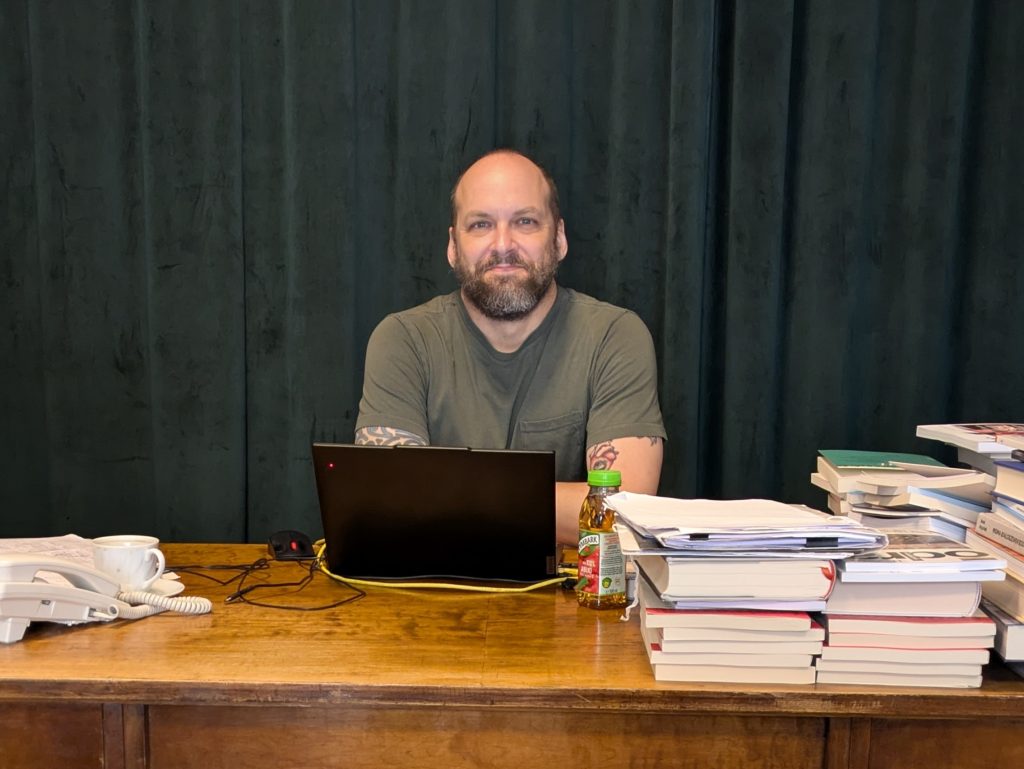
Benjamin Paloff chairs the Department of Slavic Languages and Literatures at the University of Michigan, where he is also Professor of Comparative Literature and a faculty affiliate of the Frankel Center for Judaic Studies and the Copernicus Center for Polish Studies. His most recent books are Worlds Apart: Genre and the Ethics of Representing Camps, Ghettos, and Besieged Cities (Columbia University Press, 2025) and Bakhtin’s Adventure: An Essay on Life without Meaning (Northwestern University Press, 2025); vs Computer, his third collection of poems, is forthcoming in 2026. He has translated about a dozen books and many shorter literary and theoretical texts from Polish, Czech, Russian, and Yiddish, notably works by Dorota Masłowska, Marek Bieńczyk, Richard Weiner, and Yuri Lotman, and he has received grants and fellowships from the Michigan Society of Fellows, Stanford Humanities Center, and National Endowment for the Arts, among others.
David A. Goldfarb, Host & Producer
Bartek Remisko, Curator and Executive Producer
Natalia Iyudin, Produce
Image:
Fredro and Wyspiański from © Wikimedia Commons. Przybyszewski by © Edward Munch, 1895, Munchmuseet.
Benjamin Paloff at Iwaszkiewicz’s Desk at Twórczoś, photo credit © Darek Foks, 2025