

L’Homme au crane rasé is one of the first Belgian films with an international career. The screenplay of this debut film by André Delvaux, one of the classics of Flemish magic-realist cinema, is based on the novel of the same name by Johan Daisne. The main character, lawyer Govert Miereveld, teaches at a girls’ school in a provincial town. He harbours a secret platonic love for his pupil Fran, which plunges him into a downward spiral of mental disorientation.
FRAN
’Fran’ is the first word pronounced in the film, Fran/Eufrezia Veenman’ is played by Countess Beata Tyszkiewicz (Beata Maria Helena Tyszkiewicz-Kalenicka).
The Polish actress was born into a Polish noble family on 14 August 1938. In 1955, she made her film debut as a 16-year-old schoolgirl.
From 1958 to 1959, she studied drama at the Drama Academy in Warsaw. Afterwards, she was expelled from school because of her noble descent.
She did not return to film until 1960. She made her breakthrough as an actress with the film Manuscript Found in Zaragoza (1964) by Wojciech Jerzy Has. In the 1960s, she often played noble roles in costume dramas such as The Doll by Wojciech Has and The Ashes by Andrzej Wajda. She worked together with leading directors such as Agnieszka Holland, Krzysztof Zanussi, André Delvaux and Andrzej Wajda. Tyszkiewicz played in more than a hundred films, including the biopic about Édith Piaf, Édith et Marcel (1983) by Claude Lelouch and La Petite apocalypse (1993) by Costa-Gavras.
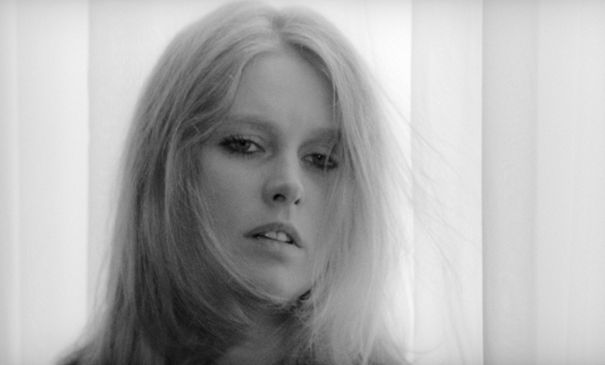
As Gertjan Willems writes in his essay, the female characters in the film are far less present and occupy subordinate, submissive roles. Fran is the only significant female character in the story. She is a thread running through the entire film. From the first scene to the last, she embodies not only Govert Miereveld’s desire but also the grey zone between reality and fiction, so essential to Delvaux’s magical realism. Through the female character, the film navigates the boundary between the external world and the inner world. It is up to the viewer to decide what is real and what is not. Fran is not the sexual object of the film; rather, she is Govert’s muse—his inspiration, his adoration, his strength, and his vulnerability. She is the star of Govert Miereveld, from the graduation ceremony where she performs a romantic song to their unexpected meeting at the hotel years later, when she has become the diva who affects Govert’s sense of masculinity. “The madman is the other,” Delvaux used to say. The distinction between Govert’s reality and the reality of the external world is therefore irrelevant.
André Delvaux met the Polish actress while making a large documentary series on Polish cinema for Belgian television. He was immediately impressed and eventually chose her for the role of Fran/Euphrasia Veenman, much to the delight of Daisne, who praised her performance enthusiastically.
In addition to discussing the importance of the female character, Gertjan Willems also elaborates on the national and international success of this modernist masterpiece, which can undoubtedly be placed on the same level as the works of Michelangelo Antonioni, Ingmar Bergman, Jean‑Luc Godard, and Agnès Varda.
Context
Gertjan Willems is a film and media specialist. He teaches at the University of Antwerp and is a postdoctoral researcher at the Centre for Cinema and Media Studies at Ghent University. For CINEMATEK and CINEA, he wrote an essay on L’Homme au crâne rasé, in which he analyzes the characters in depth, situates the film within the Belgian and international historical context, and draws attention to some striking details. The full essay contains several revelations about the film. It is up to you to decide whether to read the text on the CINEA website before or after watching this fascinating film. Be sure also to watch this short introductory video by Gertjan Willems about André Delvaux and his work, based on the restored version of L’Homme au crâne rasé.
21 March at 7:00 PM
CINEMATEK, 3 Rue Ravenstein, Brussels
BOOK YOUR TICKET
On the occasion of the centenary of the director, the programme “2026 – The Year of Andrzej Wajda”, and as part of CINEMATEK’s “André Delvaux Centenary” cycle.