

Polish Army put up military resistance and expected the Allies’ reaction. On 3 September 1939, France and the UK declared war on the German Reich but did not take any real military action. Poland’s tragic fate was sealed on 17 September 1939 when the Soviet Union launched the invasion of Poland from the East. The attack of the German Reich and the Soviet Union resulted from the Molotov-Ribbentrop Pact signed by the two totalitarian regimes, a secret protocol to which effectively divided Central Europe into the so-called spheres of influence.
On 1 September 1939 at 4:45 a.m., the German Reich army started to carry out the Fall Weiss plan. The codenamed attack on Poland unfolded along a 1,600-kilometre long frontline. The military depot on Westerplatte defended by a Polish garrison for one week, became a symbol of the first-day resistance. In this campaign, German commanders used the unprecedented tactic of “lightning war” (so called “Blitzkrieg”). Overwhelmed by the enemy and at technological disadvantage, Polish Army units were forced to retreat into the interior of the country during the first days of the campaign. However, owing to the Polish soldiers’ efforts, the timeline of the Fall Weiss plan was not carried out in full.
https://youtu.be/xq6BzMn-e-0
The Polish Army put up a stout resistance against the invaders. The campaign’s greatest struggle was the Battle of the Bzura which lasted until 22 September. Despite Poland’s defeat, it made the German Reich change its plans and delayed the surrender of Warsaw until 28 September 1939. Last Polish troops surrendered on 6 October 1939, but some units still put up resistance, engaging in operations against the German invader, like Major Henryk Dobrzański’s (a.k.a. “Hubal”) Separated Unit of the Polish Army which struggled until mid-1940.
On 17 September 1939, another neighbour launched its attack – the Soviet Union. Upon the attack, Polish authorities were still in the country and the army were still fighting the German Reich. The necessity to mount military resistance on the eastern border weakened the Polish Army and doomed it to lose the defence war of 1939.
Both the German Reich and the Soviet Union wanted not only to seize the territory of Poland but also to carry out their plans to annihilate the intelligentsia and to gradually destroy the Polish nation. Many civilians were killed in the German Reich’s air raids in the very first hours of the war. The German Reich consistently implemented its plan of murdering the Polish intelligentsia as part of the so called Intelligenzaktion and AB (Außerordentliche Befriedungsaktion) campaigns.
The occupiers started mass exterminations of the population inhabiting the Polish territories, and continued their mass killings until practically the last day of the Second World War in 1945. The Nazi invaders also carried out a programme of mass extermination of the Jewish population. Contrary to the occupied countries of Western Europe, helping Jews in the occupied Poland was punished with death.
On the Soviet territory, Poles were imprisoned and deported on a mass scale. They were forced to slave labour, in horrible life and hygienic conditions, given starvation rations and constantly threatened by criminal prisoners.
Poland continued to put up resistance against the occupiers at home and abroad despite losing the defensive war of 1939.
The structures of Polish underground state were the largest in the whole occupied Europe and included independent armed forces, parliament, the judiciary and secret education. Polish Army was also revived in France and the UK, fighting on all European and African frontlines. Polish Armed Forces in the USSR were only established after the German Reich’s attack on the USSR on 22 June 1941 and upon signing the Sikorski-Mayski agreement. Poles greatly contributed to the Allies’ victory and the ending of the Second World War, yet 1945 did not bring freedom for Poland. Europe became divided under the arrangements made during the Yalta Conference. Used by Churchill in Fulton, the notion of „Iron Curtain” described the post-war division of Europe and the enslavement of Poland and other countries, now in the Soviet sphere of influence. Poland regained its full independence as late as in 1989.
https://youtu.be/R2EL3bik99s
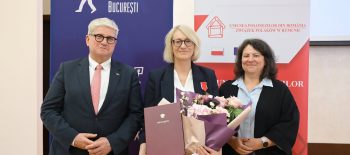
Distincția Bene Merito pentru Elżbieta Wieruszewska-Calistru 🗓
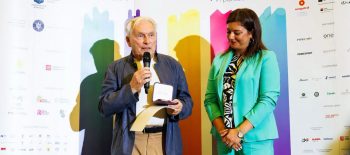
Maestrul Zygmunt Krauze, distins cu Medalia „George