

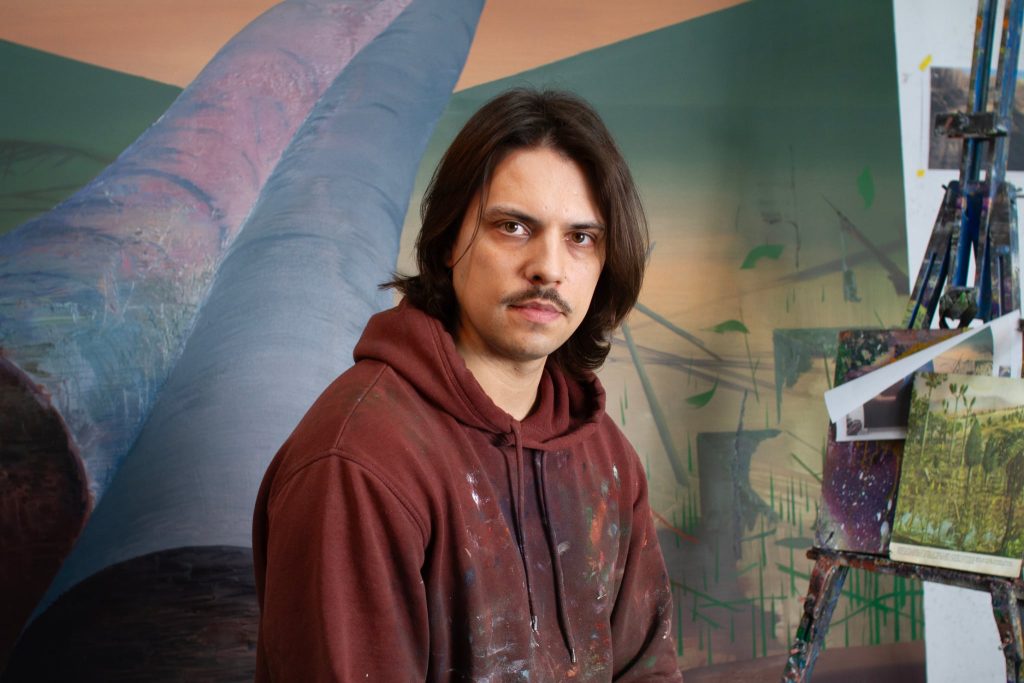
In recent years, Kamil Kukla’s painting has turned decisively toward darker registers: biological forms, catastrophic premonitions, and unsettling images drawn from everyday life. Do we still inhabit a “gracious epoch”? Kukla’s solo exhibition Gracious Epoch poses precisely this question, weaving together biological imagination with the experience of contemporary crises. The artist speaks about paintings that emerge somewhere between improvisation and the found motif, about painting as instinct, and about a world perceived as though through a thin membrane of unreality.
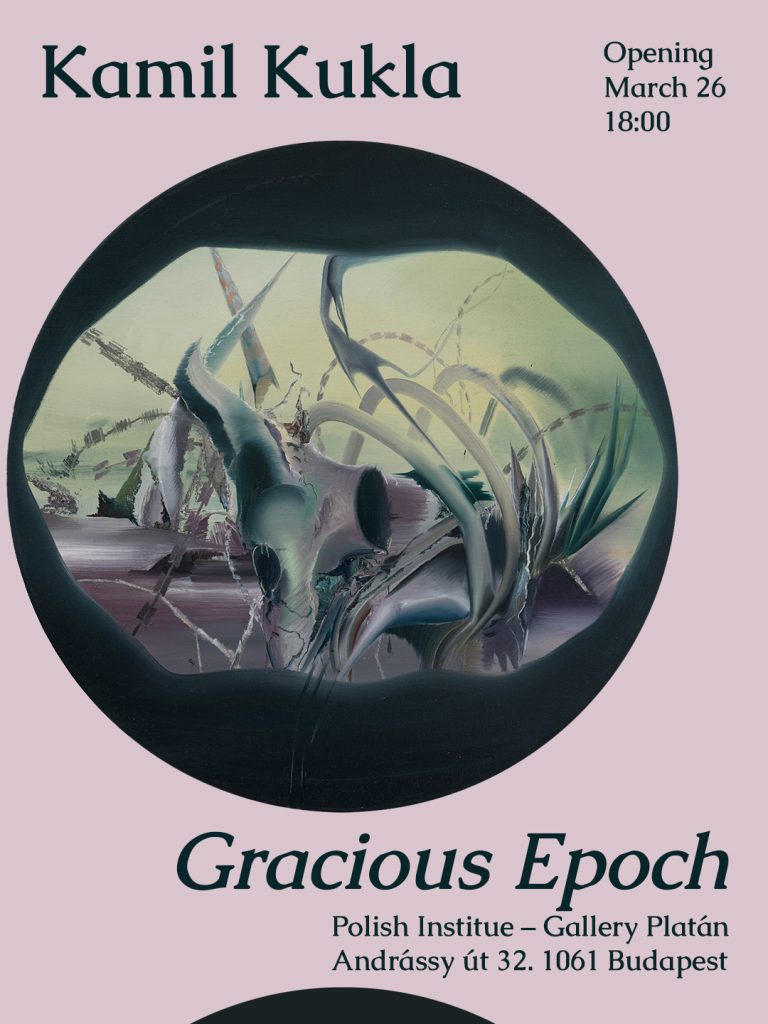
Patrycja Rup: The exhibition Gracious Epoch at Galeria Platan brings together works from different moments in your practice. When arranging the show, were you aiming to construct a particular narrative or tension between the works?
Kamil Kukla: The exhibition consists of paintings made between 2022 and 2025. Since the outbreak of the coronavirus pandemic, my painting has undergone a noticeable shift. The Russian aggression against our closest neighbors, the migration crisis at the Belarusian border, and the broader political turbulence in the country also had a significant impact. All of this produced a strong sense in me that it was impossible to go on painting as though these shocks had never occurred. Some of the works in the exhibition are a record of that moment.
Of course, my paintings are not an objective report, nor are they a form of interventionist painting. Rather, they register an internal state: emerging premonitions, dreams, apparitions. The war is close, after all, but in Poland we do not experience it directly. Everything unfolds as if behind a very thin membrane that lends events an air of unreality.
PR: What does Gracious Epoch mean to you?
KK: The title carries a bitter irony, because it is difficult to regard the present historical moment with gratitude. The climate crisis is intensifying; we stand on the threshold of ecological catastrophe, while the era of liberal democracies is visibly eroding. Everyday reality reminds us that international agreements meant to safeguard peace, human rights, and stable borders are little more than scraps of paper to increasingly powerful autocrats.
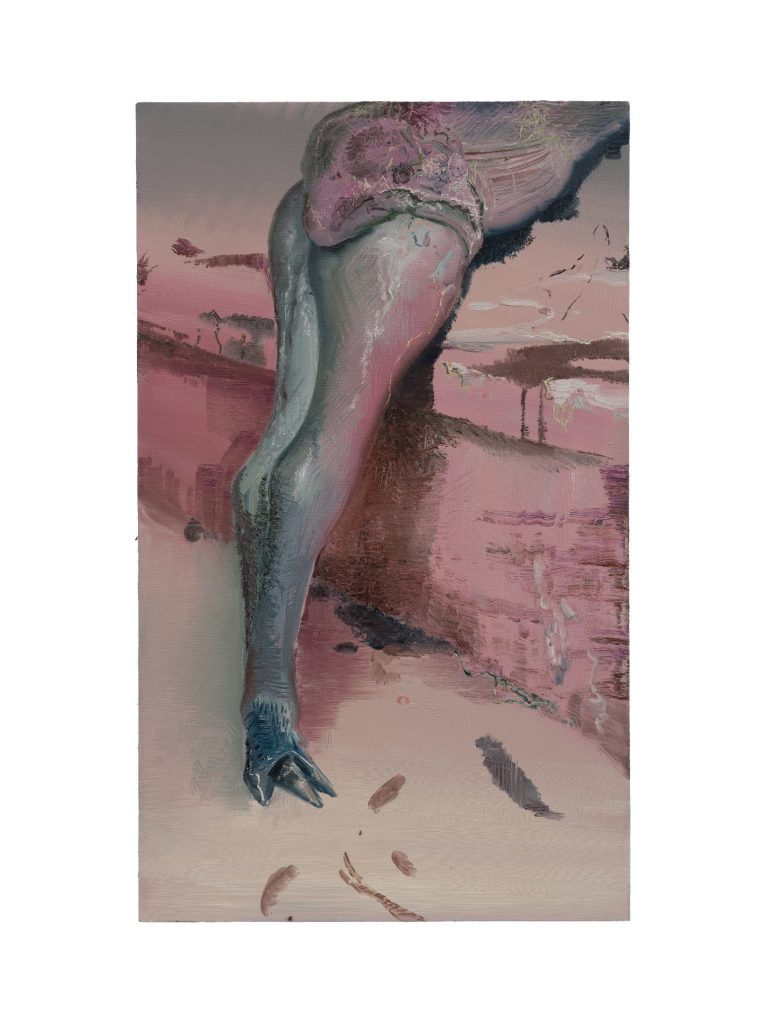
At the same time, I believe that the “gracious epoch” is still a not entirely closed window of civilizational possibility. In the exhibition I show several paintings that refer to paleo-art, depicting the remote history of Earth, including times before the emergence of hominids. For much of the Phanerozoic, reptiles ruled the world, and only a sheer accident—a deadly asteroid—opened a new epoch, which turned out to be gracious to mammals.
In the postglacial landscape of the Holocene, humanity was able to develop under remarkably favorable conditions, growing in strength and numbers. Yet today that very fertility and graciousness of nature appear to have become our curse. There are too many people, the destruction is too vast, and the world lies in the hands of foolish and malevolent leaders. This window of possibility seems to be closing, and the gracious epoch is drawing to an end.
PR: In this exhibition, is the viewer more of an observer, or rather a participant in an immersive experience?
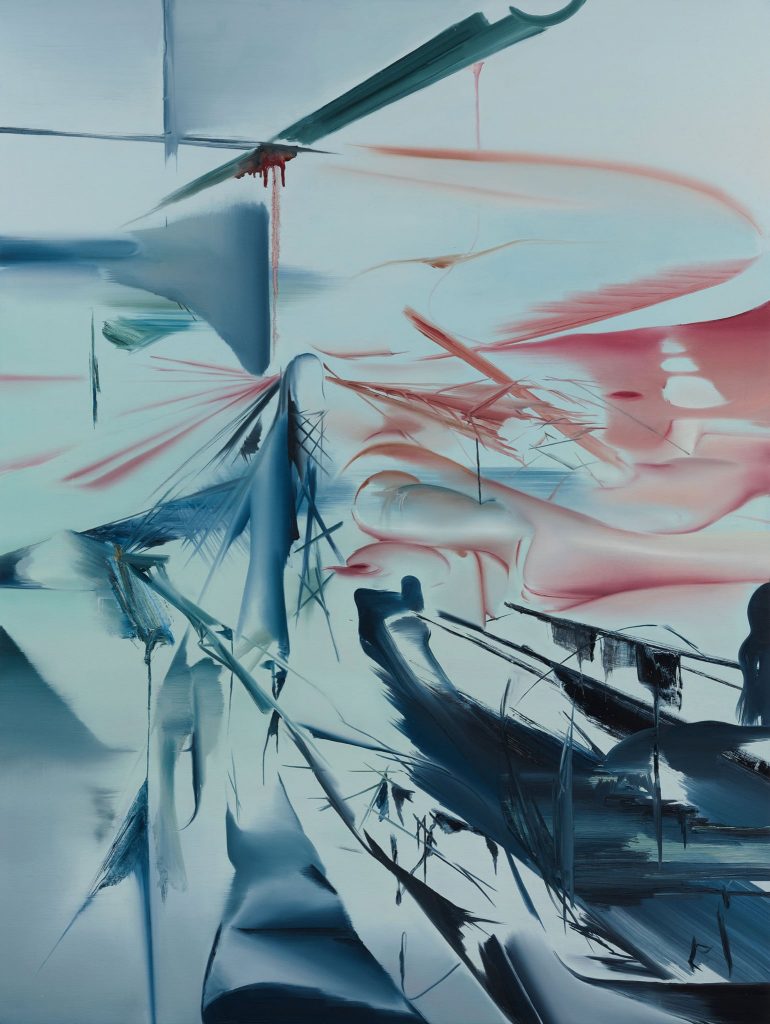
KK: When I paint, I attach great importance to formal aspects. I want the fabric of the painting to be a living record of inner energy and of the way I think about the world. There is, of course, a figurative dimension with narrative overtones, something the titles often point toward, but the sensuality of color, material, composition, and individual forms is equally important to me.
I hope that this non-intellectual, emotional dimension becomes one of the bridges between me and the viewer. The issues and contexts that can be named and itemized matter to me, but what remains crucial is how a painting is made and where a given painter’s vitality reveals itself. I do not value works that speak about important and righteous matters but in which talent has to be searched for with a magnifying glass.
PR: Is there a particular painting in the show that feels closest to you right now? If so, what determined that choice?
KK: Rather than individual paintings, I am more interested in the way they interact within the exhibition space. The tensions between works are as important as the internal content of each canvas. In that sense, I fully agree with Wilhelm Sasnal, who once neatly remarked in an interview that arranging an exhibition is also a form of painting.
What particularly interests me when composing a show is the resonance between abstract paintings and those that are openly figurative, strongly based on photographs or reproductions. It is fascinating how the reception of a work changes depending on its neighbors and the broader context.
PR: In the context of this exhibition, what role do you assign to painting today: is it a tool of critique, introspection, or the construction of an alternative visual reality?
KK: For me, painting is a fundamental instinct, and it would not be an exaggeration to say that it is also my way of life. On the one hand, it is a tool that allows me to continually process the world available to me; on the other, it is a way of reaching into an internal reservoir.
I feel very close to what Kafka wrote about the role of literature, describing it as “the axe for the frozen sea within us.” For me, that is the essential function of art in general. If it does not carry the ambition to reach toward mystery, then it becomes little more than ego-driven commentary sliding across the surface, or eye-pleasing content.
PR: How does your work on a painting usually begin, does it start with a specific idea, a sketch, or perhaps with a patch of color?
KK: Over the past few years, two seemingly contradictory currents have coexisted in my work. There is a whole series of paintings that originate in a photograph, a reproduction, a screenshot, sometimes an image of a situation I staged myself, or a sketch. In those cases, the spark for a painting comes from something seen. An external situation triggers a kind of neuronal spark and mobilizes me to paint. It is a capricious and elusive mechanism, but a very powerful one.
The second current consists of works that are pure improvisation, where the hand simply meanders. These paintings grow from a single stain, an almost automatic gesture, and they often change drastically in the course of painting. Here the role of chance is greatest, and my task is either to accept it or to wipe it away with turpentine or scrape it off with a palette knife.
PR: In your works abstraction often mixes with something organic, corporeal, sometimes even biological. How do you see this relationship yourself?
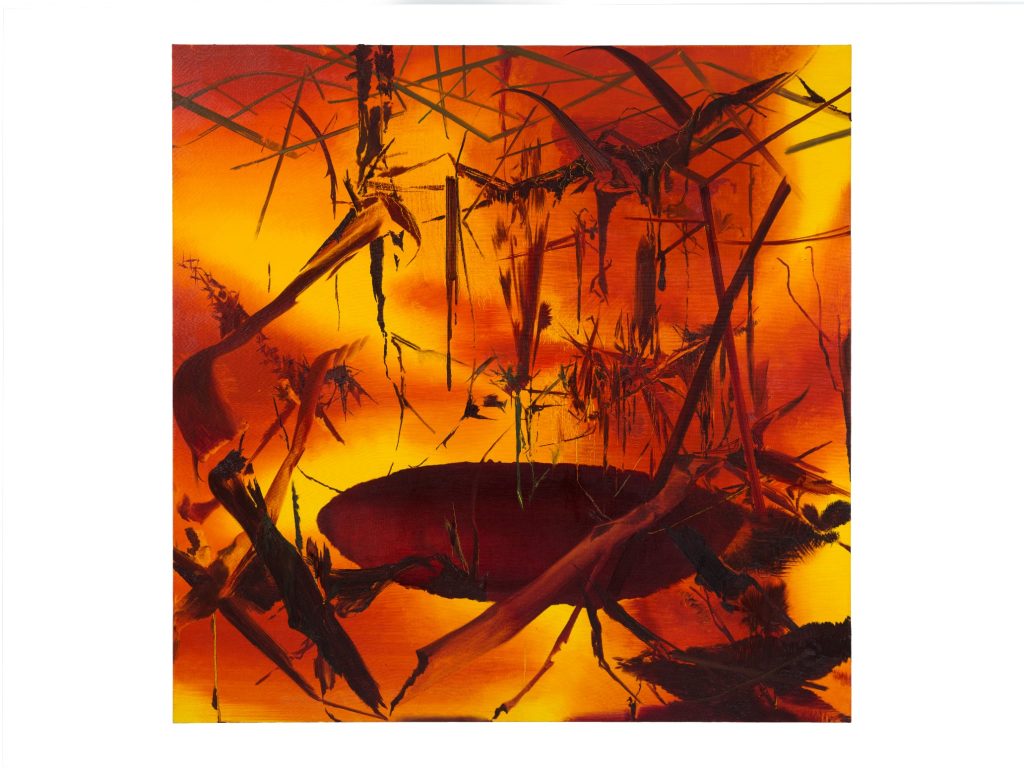
KK: This biological aspect is indeed very important to me. Even when painting seemingly non-representational works, I think about the body—whether human or animal—but also about the biosphere in general, an amalgam of different kingdoms: from plants to fungi feeding on dead organic matter.
I am always fascinated by fossils, which are assemblages of various compressed animal remains. I am interested both in individual life and in biological mass, in which single organisms are merely insignificant bricks. At one time I painted quite a few travesties of Flemish still lifes, and to this day I remain fascinated by those piled masses of dead animals that seem to spill directly out of the canvases of Frans Snyders and similar painters.
Just yesterday I watched a documentary about the fishing vessel Leviathan, where life is reduced to compressed biomass processed by humans with the indifference of a machine. There is a lot of Snyders in it, because those horns of plenty pulled from the water are simultaneously striking memento mori. The originality of the film lies in the fact that we observe the entire procedure from a fish’s perspective. That nonhuman perspective is something I feel very close to.
PR: How would you describe today the field of themes that most interest you in your artistic projects?
KK: I must admit that my favorite place to visit is the museum. I look at everything with voracious curiosity: from old masters to contemporary art, finding something exciting in every period. The chronological order of collections can be tedious, but it also offers that sweet pleasure of a well-known comfort movie.
These walks also have a practical dimension: they are hunts for motifs. I pick out entire paintings or fragments that later serve me in my own painterly pastiches. Over the years I have produced quite a number of such works, and it is probably one of the longest-running cycles in my practice.
PR: Can you reveal anything about your upcoming plans and what you are currently working on?
KK: Gracious Epoch brings together works created over the past few years. My newest paintings will be presented in April this year in a solo exhibition at the Pani Domu gallery in Poznań. I will show recent canvases in which the motif of trees and forest has begun to appear repeatedly.
These works will be presented alongside gouaches on paper and sculptures. The works on paper are made quickly, usually in a single sitting and without prior preparation. The sculptures, by contrast, are produced in a laborious though improvised process. At times it seems to me that each of these fields is overseen by a different persona. The methods of arriving at form differ, but the imperative is shared, and it seems that I always draw from a similar source.
Kamil Kukla (b. 1989) is a painter and creator of digital graphics, objects, and experimental music. In 2013 he graduated from the Faculty of Graphic Arts at the Academy of Fine Arts in Kraków. Since 2014 he has taught at the Faculty of Art at the University of Applied Sciences in Tarnów. In 2017 he participated in two artistic residencies: at MeetFactory in Prague and at Dukley Art Center in Kotor, Montenegro. In 2016 he received the Grey House Foundation Award, and in 2018 he was a finalist for the Vordemberge-Gildewart Foundation Award.
He is the author of numerous solo exhibitions, including Frukta i paszczęki at Bunkier Sztuki Contemporary Art Gallery in Kraków (2019), U+1F351 PEACH at Ujazdowski Castle Centre for Contemporary Art in Warsaw (2017), and UTROPA at BWA Tarnów (2022). His works are held in the collections of the Museum of Contemporary Art in Kraków (MOCAK), the National Museum in Gdańsk, the Bunkier Sztuki Contemporary Art Gallery in Kraków, as well as in numerous private collections. He lives and works in Kraków.
Patrycja Rup (b. 1989) is a Polish art curator, event producer, and writer. She has lived and worked in Budapest since 2015. Her texts have been published in Contemporary Lynx, on the audio album Pieces, in The Room Surrealist Magazine, in the anthology Narratives of Budapest, in the Budapest Business Journal, and in Panel Magazine.