A conversation with Jakub Ciężki.
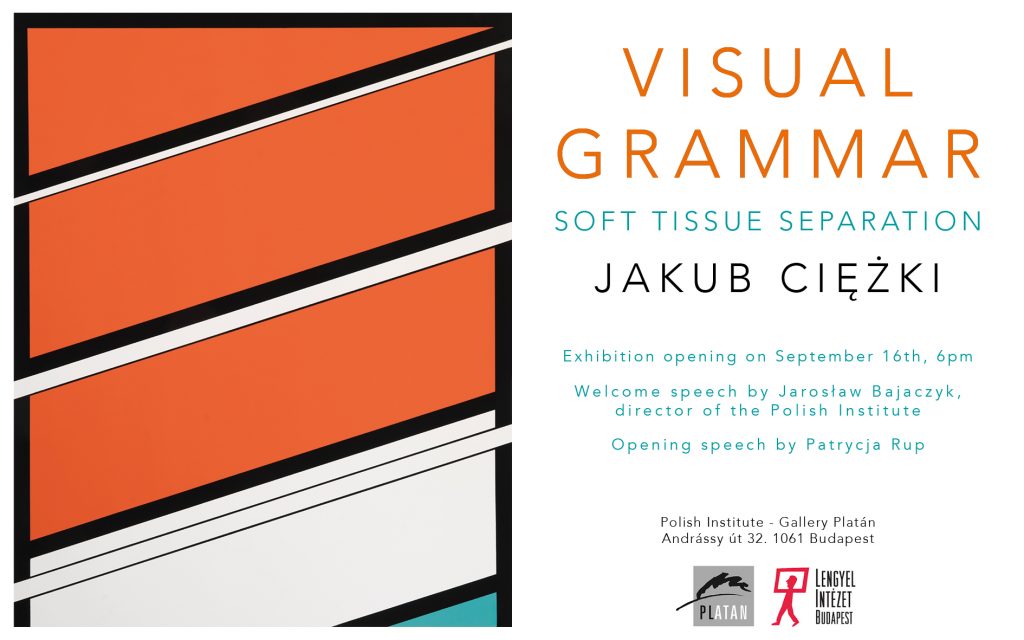
What does it take for a painter to abandon figurative art? For Polish artist Jakub Ciężki, it has meant years of slow, deliberate work: a steady dismantling of representation in favour of abstraction. Known for his large-scale canvases that confront the viewer, Ciężki approaches painting like a system of construction, where geometry, colour, and scale set the rules. His latest exhibition, Visual Grammar. Soft Tissue Separation, gathers recent works and sketches that trace this evolution. It also places him within a broader return to abstraction now visible on the international scene, particularly in Hungary. For Ciężki, however, abstraction is not a trend but a personal necessity: a way of rebuilding painting from its very foundations.
We invite you to read the latest interview with the artist where he shares his observations on the creative process, thoughts on the new exhibition in Platan Gallery and reveals upcoming projects.
Our last collaboration in Budapest, Sudden Death of a Hero, took place in April 2018. A lot has happened in these seven years. How has your painting style and your themes evolved since then?
A great deal has changed over these seven years. My painting has gone through a real evolution. After many years, I finally managed to free myself from the subject — from representation itself. I had long wanted to work abstractly. All of my favourite painters are abstractionists (among them Bernard Frize and Frank Nitsche), but for a long time I couldn’t break away from what I had been taught back in art school. I’m not impulsive by nature, so I allowed this change to unfold slowly and methodically. It was an evolution, not a revolution. Eventually the subject disappeared altogether, and for several years now I’ve been painting purely abstract works.


In your new exhibition at the Platan Gallery in the Polish Institute, visitors will see works from different series. What guided this particular selection?
The exhibition brings together a set of fairly recent works. I wanted viewers to experience my latest pieces as directly as possible. Together with the curator, we chose works that not only fit well into the gallery space but also reflect the broad spectrum of what I’m currently exploring. The show is also enriched by a selection of sketches on paper. For the first time, I’m presenting these sketches publicly — in Visual Grammar. For every painting, I create a series of preliminary sketches, sometimes more than a dozen, and then choose the one that feels right. Including these studies allows me to share the process itself: the search for a visual language, for a kind of grammar of painting.
What inspired the title Visual Grammar. Soft Tissue Separation?
It’s about the process and my evolution as a painter. About how the subject began to disappear from my works, as if the soft tissues were evaporating from them. Soft tissue separation leading all the way to hard-edge abstraction — down to the skeleton, the essence, the structure, the very foundations of painting: the colour field and the line. And besides, Budapest is the birthplace of one of the most important representatives of hard-edge abstraction – Imre Bak.
Among the works presented, is there one that feels most important to you, and why?
I don’t think I have a single favourite, as they’re all favourites in a way. What sets these works apart from those I created in the past is not just the shift in subject matter, but also a change in how I relate emotionally to the painting process. Years ago, I found the act of painting itself most significant, the materiality of the paint, its physical qualities. Today, the most thrilling moment for me is the idea: that initial spark of the concept. That’s when the real excitement happens.
Could you tell us more about your creative process?
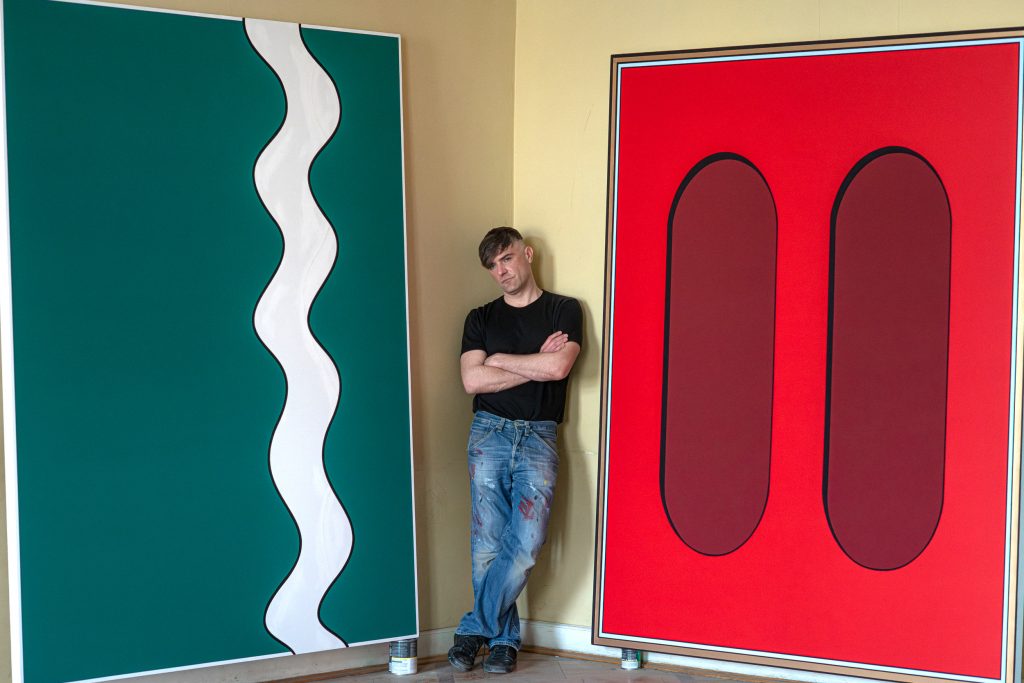
As I mentioned, I begin each painting with a series of sketches, from which I choose the one that becomes the foundation for the final work. Quite often, the preparatory stage lasts longer than the act of painting itself. More than a decade ago I switched from oils to acrylics, which allowed me to skip the long drying process. Acrylics also let me create large, flat fields of colour: an effect especially important in the large-scale canvases I love to work with. I should also mention the black in these works: it’s a special paint, the deepest, most matte black available, almost velvety to the eye. In my paintings, black carries great weight as it provides the structure of the composition.
Large-scale canvases have become something of your trademark. What led you to this artistic choice?
I believe scale has an enormous impact on how we experience a painting, at least in my own practice. When you stand before a large canvas, its size and presence can be overwhelming. It begins to draw you in, almost like a portal into another world or another dimension. That effect is very powerful for me, and I assume it can work in the same way for the viewer.
What themes or concepts would you like to explore in future series? Is there a new medium you’re tempted to experiment with?
For now, I remain very focused on abstract painting, but I do have ideas for more spatial works. A few years ago, I created several sculptures and installations, and I’m increasingly drawn to returning to that direction. I’m also thinking about working with oil paint again. But if I do, it certainly won’t be for figurative painting.
Can you share more about your upcoming projects?
I have many exhibition plans for the end of this year and throughout next year. But there’s one event I’m especially looking forward to — an exhibition at the National Museum in Lublin toward the end of next year. My works will be shown alongside those of one of the most important figures in Polish abstract art, now deceased. Unfortunately, I can’t reveal more details just yet.
And finally: a dream come true for you this year?
One has already come true: the exhibition in Budapest. And I’m also hoping for a new, larger studio.
Thank you for the interview!
If you want to see Jakub’s paintings in person, we invite you to join the vernissage on September 16, 2025 at 6pm in Platan Gallery or visit the exhibition during the gallery’s regular opening hours.
Patrycja Rup is a Polish art curator, event producer and writer. Living & working in Budapest since 2015. Her writings were published in Contemporary Lynx Magazine, Pieces audio album, The Room Surrealist Magazine, Narratives of Budapest collection and recently in Panel Magazine.