

The Imperfect Future – WOOD: Design between Symbiosis and Standardisation
Registration: HERE
Language: English
What does it mean for design when materials are not perfect?
Next! Young European Design by EUNIC Berlin and Aedes brings together young designers from eleven European countries to discuss wood as a material in the context of climate change, resource scarcity and new production methods. The Imperfect Future – WOOD: Design between Symbiosis and Standardisation examines how designers are responding to flawed materials, the slow growth cycles of natural resources and the tension between craftsmanship and industrial standardisation.
The talk opens with short presentations by invited designers and studios, whose work ranges from experimental furniture and material research to site-specific design approaches. Some engage with locally sourced or reused wood, while others explore news forms of collaborations against the backdrop of natural growth processes or develop strategies for durable, sustainable products.
These presentations are followed by a moderated discussion addressing the origins, uses and future of wood and asking how imperfection, reparability and material constraints can become productive starting points for contemporary design.
The Lab Talk forms part of the wider Next! Young European Design programme, which includes studio visits, workshops and exchange formats for participating designers. The programme is developed in collaboration with partners including the Werkbundarchiv –Museum der Dinge, the Wood Design programme at the Schneeberg Faculty of Applied Arts, the project BeFallen- Art from Infestation and Studio J.Mayer.H.
PROGRAMME
Welcome and Introduction
Dunya Bouchi, Aedes, Berlin
Saša Šavel Burkart, Head of the Slovenian Cultural Information Center – SKICA Berlin and Lead of Next! Young European Design by EUNIC Berlin
Simona Binko, Art Historian and Cultural Manager / curator of Next! Young European Design, Berlin
Presentations
Jakob Niemann, Austria
Mirjam and Markus Pärnamets, House of Pärnamets, Estonia
Henri Judin, Design Studio Judin, Finland
Lucy O’Sullivan, Ireland
Cathy Wolter, Luxembourg
Pim van Baarsen, Netherlands
Beata Mielus, Poland
Cezar Blînda, LUN.Studio, Romania
Richard Seneši, Slovakia
Aljaž Celarc, Hiša Mandrova, Slovenia
Darren Appiagyei, United Kingdom
Discussion
with the designers and the audience, moderated by Simona Binko
Beata Mielus, Poland:
After working in the fashion industry and witnessing the realities of fast fashion, Beata Mielus changed direction and studied Design at the Academy of Fine Arts in Gdańsk.
This experience shaped her focus on product life cycle, durability and long-term impact. She works across furniture and product design, research, prototyping and photography, and expands her practice through training in carpentry and basketry. She has collaborated with Studio Rygalik and Studio 1:1 and now works independently on commissioned and self-initiated projects. Her works were shown at Salone del Mobile, Dutch Design Week, MaterialDistrict Utrecht, Interzum and Gdynia Design Days.
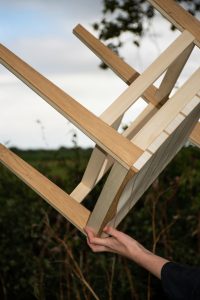
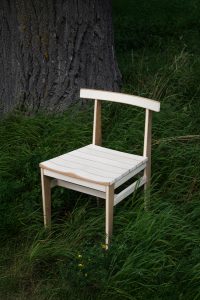
Poplar is a soft hardwood with high production potential but limited durability. In the presented project, she shows that, when structurally considered and combined with oak, poplar can offer strength and aesthetic value in furniture design.


Kulturgutschutz im Weimarer Dreieck 🗓
Polish representation at Forward Festival Berlin 2026