

These two books launch the Polish Institute in Brussels’ collection “Lire la Pologne / Czytać Polskę” (“Reading Poland”). Its aim is to introduce an international audience to the richness of Polish literature, in the original language and in French and/or Dutch translation. The collection will include both classics and contemporary works, in order to encourage the circulation of texts and dialogue between languages and cultures.
Adam Mickiewicz (1798–1855), a leading figure of Polish Romanticism, is one of the most important authors in Polish literature. Dziady, one of his seminal works, combines poetry, theatre, folk traditions and political reflection. In it, Mickiewicz portrays, among other things, a people deprived of freedom and struggling to preserve their identity, while also questioning the role of the artist in the face of an oppressed community. For nearly two centuries, the work has inspired writers, artists and theatre directors, and it continues to hold an important place in Polish culture.
Editorial work carried out in Brussels
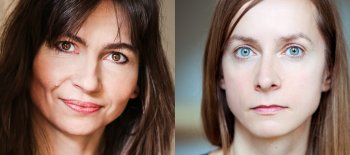
The French version of the work was translated by Xavier Mottez, whose collaboration played an essential role in the realisation of the project.
Publishing the two volumes required several stages: preparing and checking the texts, successive proofreadings, corrections, typographic harmonisation and design of the layout. The layout was produced by the Polish Institute in Brussels, with particular attention to reading comfort and to a shared identity for the Polish and French editions.
A cover by Roman Cieślewicz
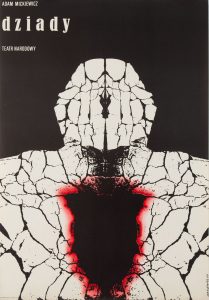 Roman Cieślewicz – “Dziady”, 1967
For the covers, the Institute chose one of the most striking visual representations of Mickiewicz’s work: the poster created in 1963 by Roman Cieślewicz for the staging of Dziady at the National Theatre in Warsaw.
Roman Cieślewicz (1930–1996) is one of the major figures of the Polish School of Posters and of 20th-century European graphic design. Based in Paris from 1963, he developed a distinctive visual language built notably on photomontage, collage and the reappropriation of images.
Thanks to the agreement of the rights holders, this emblematic poster could be used for both editions, giving them a shared visual identity.
Robotic printing at Quartier Libre
The books were produced in Brussels in collaboration with the bookshop Quartier Libre, in its printing workshop, QL PrintLab. Its printing robot, named Gutenberg One, can produce a book on demand in five minutes, the time it takes to drink a coffee.
Working from digital files, this technology prints the text and the cover, then assembles, binds and trims the books on site. This method is particularly well suited to small-run publishing projects. It makes it possible to produce only the copies needed, without having to launch a large print run or build up large stocks. It also supports a short supply chain: the books were prepared and printed in Brussels, in partnership with a local bookshop.
With Dziady / Les Aïeux, the Polish Institute in Brussels opens the first chapter of “Lire la Pologne / Czytać Polskę”. This new collection is a concrete extension of its mission: to promote the Polish language and Polish literature in Belgium and make them accessible to new readers.
Produced in a cultural setting and entirely non-commercial, this project helps to make Polish literature known beyond its borders. To obtain a copy of Dziady or Les Aïeux, simply contact the Polish Institute in Brussels or make an appointment at the bookshop Quartier Libre.
Get a glimpse of the printing process by clicking here.