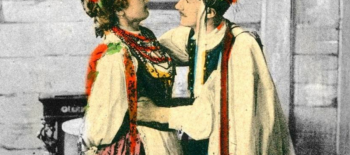


Among the cafés of Warsaw in the 1920s, an exceptional genre flourished: szmonces — a cabaret form in which comic dialogues, monologues, and songs portrayed urban life, the bourgeoisie, and the new era. The protagonists — most often Jews — used humor and satire to question the norms of the emerging Polish society.
Szmonces performances often employed exaggerated Jewish stereotypes — accent, speech patterns, Yiddish-Polish language — but it was precisely this exaggeration that opened a free space for a conversation about identity. The cabaret was a place where it was permissible to “laugh at the king,” to break hierarchies, and to say on stage what could not be said outside it. It allowed Jewish-Polish figures to exist in all their complex duality — not merely as caricatures, but as a critical mirror of the period.
One of the creators who brought this language to new heights was Antoni Słonimski (1895–1976). A poet, satirist, columnist, and intellectual, Słonimski was born in Warsaw to Jewish parents who had converted to Christianity. He published his first poem at the age of 18. Although born a Christian, he was proud of his Jewish origins and maintained them as part of his identity. For many Jews, he was a Christian; for Polish nationalists, a Jew. Słonimski refused to choose between them. “Too poor choice, gentlemen,” he once said.
In addition to poetry, he wrote prose, plays, essays, and opinion columns. He was one of the founders of the Skamander poets’ group, one of the cornerstones of Polish poetry between the two world wars, which shifted poetry away from national pathos toward everyday life and the city.
Yet despite all this, his main livelihood came from elsewhere – feuilletons. Between 1926 and 1928, he published the weekly column “Weekly Chronicle” in Wiadomości Literackie. There, Słonimski’s sharp wit fully emerged — a combination of irony, humor, politics, cultural criticism, and an intelligence that spared no one.
The Second World War interrupted his life. He fled Poland, lived in exile in Paris and London, and only in the early 1950s returned to Poland, into a harsh communist reality. In the 1960s, he became one of the intellectual symbols of opposition to the regime, particularly on issues of freedom of expression, authors’ rights, and artistic freedom.
The figure of Antoni Słonimski — one of the most prominent voices of Jewish-Polish writing in the 20th century — has been almost unknown to Hebrew-language readers until now. On the occasion of the 130th anniversary of his birth, the Polish Parliament declared 2025 the “Year of Słonimski,” and within this framework the November–December issue of the monthly journal for literature and culture Iton77 is being published, dedicated to his life and work.
The issue includes a selection of texts that portray Słonimski not as a distant classic, but as a living, sharp, and relevant writer:
-
An excerpt from the biography Słonimski: A Heretic at the Lectern by Joanna Kuciel-Frydryszak;
-
Two feuilletons written in 1926–1928 for the Warsaw newspaper Cyrulik Warszawski, translated by Miriam Borenstein;
-
Five poems in new Hebrew translations by Prof. Rafi Weichert.
This special publication is released with the support of the Polish Institute and in cooperation with Iton77, a journal that for nearly five decades has been a central home for literature, translation, and cultural thought in Hebrew. This collaboration enables a direct encounter between Israeli readers and one of the most complex, humorous, and critical voices of modern Polish culture.
The November–December issue is now available in selected bookstores and on the Iton77 website.
In addition to the publication in Iton 77, the Polish Institute also recommends a new episode of the podcast The Sages of Poland, hosted by Leman, in which we spoke with Prof. Markus Silber about Słonimski’s life and work, Skamander, exile in London, and the return to communist Poland. The podcast is available on Spotify, Simplecast, Apple Podcasts, and YouTube.
The Polish Dragon in Tel Aviv 🗓

Between History and Memory, Between Yiddish and