

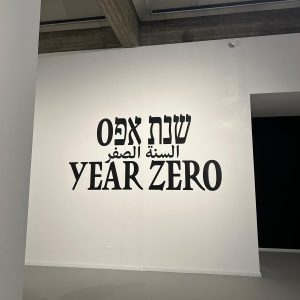
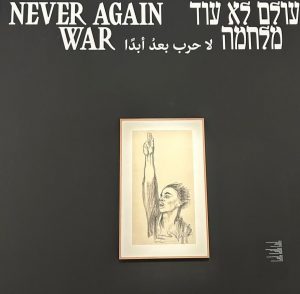
An exhibition “Year Zero” brings together works by artists of Polish-Jewish origin who, through diverse artistic languages, engage with questions of fracture, identity, and memory, offering a Polish-Jewish perspective on pivotal moments in history and consciousness.
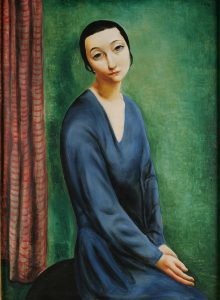
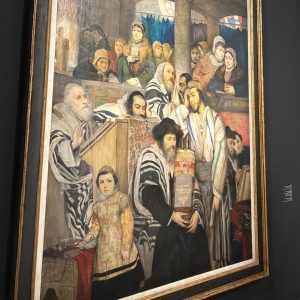
Among the works on view are pieces by Maurycy Gottlieb and Moïse Kisling, some of which were among the first artworks brought to the British Mandate of Palestine prior to World War II as part of the rescue efforts led by Dr. Karl Schwarz, the first director of the Tel Aviv Museum of Art. These works, saved from Europe between 1933 and 1945, became foundational elements of the museum’s modern art collection and testify to a cultural vision shaped under conditions of historical urgency.
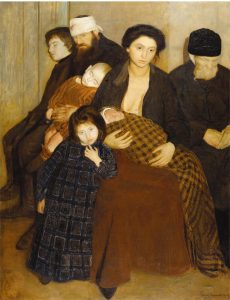
Alongside them is Maurycy Minkowski’s work After the Pogrom, which focuses on moments of rupture—when personal and collective memory is inscribed in body and consciousness and transformed into artistic material.
Together, the artists trace a Polish-Jewish continuum: from the longing for belonging and cultural integration, through experiences of rupture and violence, to an attempt to rebuild artistic language and identity after a point of zero.
Exhibition opening: December 31, 2025
Tel Aviv Museum of Art, 27 Shaul HaMelech Boulevard, Tel Aviv
Curator: Noa Rosenberg
More information on the Museum’s website
Maurycy Gottlieb (1856–1879), born in Galicia and active in 19th-century Poland, is considered one of the most prominent Polish-Jewish painters of his time. Despite his short life, his work left a deep mark on European painting. Gottlieb worked in a period when Jewish artists sought recognition within Polish national culture, and his paintings combine an academic and historical language with a charged exploration of Jewish identity, faith, and fate, reflecting a constant tension between belonging and otherness.
Moïse Kisling (1891–1953) was born in Poland and moved to Paris at the beginning of the 20th century, where he became a central figure in the Paris School and the European modernist movement. Even though he worked far from Poland, the experience of migration and his Polish roots continue to resonate in his work. His portraits and human figures are characterized by rich color and intimacy, expressing an identity being rebuilt—shaped by movement, otherness, and vulnerability.
Maurycy Minkowski (1875–1949), a Polish-born Jewish artist born in Warsaw, created After the Pogrom, which presents a direct and uncompromising view of the antisemitic violence experienced by Jewish communities in Eastern Europe and Poland in particular. The work focuses on the aftermath—when history leaves a deep scar in consciousness and the body, transforming personal and collective memory into artistic material.
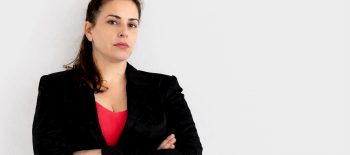
To mark the opening of “Year Zero”, a special episode of the Polish Institute’s podcast “Hachmey Polin” was dedicated to the exhibition. In the episode, we spoke with Noa Rosenberg, curator of modern and European art at the Tel Aviv Museum of Art, about the exhibition, the participating artists, and the themes of identity, memory, and rupture at its core.
During the conversation, Rosenberg also discussed the second exhibition she is currently working on, “The Return Home”, scheduled to open in 2026. She shared insights into the working process and explained how the two exhibitions together form a conceptual and historical continuum, offering a contemporary perspective on the role of Polish-Jewish art in shaping modern art.
The podcast is available on Spotify, Apple Podcasts, Simplecast, and YouTube. Enjoy!
Salon Polin hosts Noa Rosenberg 🗓

A Special Panel on Poland–Israel Relations 🗓