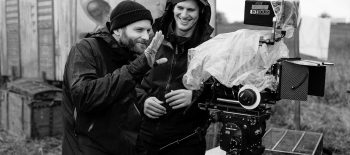


Andrzej Wajda was one of the most prominent and influential directors in Polish and European cinema. Over decades of filmmaking, he explored memory, history, identity, and the relationship between the individual and broader political and social processes. His distinctive cinematic language and his ability to connect personal narratives with Polish history have made his work an important point of reference for a new generation of filmmakers.
In collaboration with the Polish Institute in Tel Aviv, a summer course dedicated to Wajda’s work and legacy took place on 5-8 October at the Bezalel Academy of Arts and Design in Jerusalem, under the title The Social and the Political as Cinematic Image – A Tribute to Andrzej Wajda. Led by Benjamin Friedenberg, screenwriter, director, lecturer, and film scholar, the course combined theoretical study with practical work. Students watched films, analysed Wajda’s cinematic language, and explored how cinema can engage with memory, history, society, and identity. They then translated the themes and ideas discussed during the course into their own independent creative projects.
Two guests from Poland joined Friedenberg, bringing complementary perspectives on Polish cinema.
Łukasz Konopa is a Polish documentary filmmaker. He studied sociology at the University of Warsaw and earned a degree in documentary filmmaking from the National Film and Television School (NFTS) in the United Kingdom. His films have been screened at international festivals, and his film After received the CILECT Award for Best Documentary. His work combines social and human observation with a distinctive documentary approach.
Dr. Katarzyna Taras is a film scholar and historian, critic, and lecturer at the Łódź Film School. Her research focuses, among other subjects, on contemporary Polish cinema and the theory of cinematography. She has published books and articles on Polish cinema and its visual language.
Meeting Konopa and Taras allowed students to approach Wajda’s legacy from two complementary perspectives: contemporary filmmaking and documentary practice on the one hand, and film scholarship, criticism, and the analysis of Polish cinema and its visual language on the other.
The aim of the course was not simply to study Wajda as a historical figure, but to use his work as a starting point for contemporary creative practice. The combination of Benjamin Friedenberg’s guidance, direct encounters with film professionals from Poland, and hands-on work enabled students to explore how ideas of memory, place, identity, and history could find new expression in their own work.
During the course, students developed short video works inspired by the films, discussions, and materials they explored. Their encounter with Wajda’s legacy thus evolved from a process of study and reflection into a starting point for new, contemporary creative work.
The students’ works will be screened on 24 November at Cinema Spiegel, the cinema of the Sam Spiegel Film and Television School in Jerusalem, as part of a month-long tribute to Andrzej Wajda. Alongside the student films, the programme will feature screenings of three of Wajda’s most notable films, introductions by film and history scholars, and a panel discussion with filmmakers.
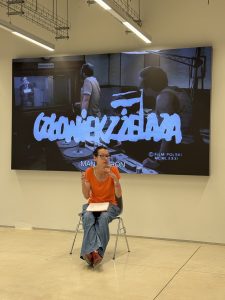
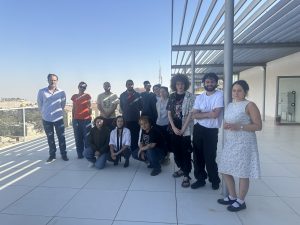
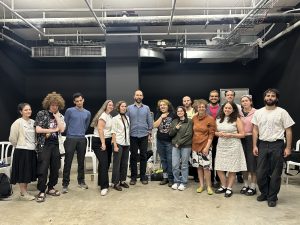
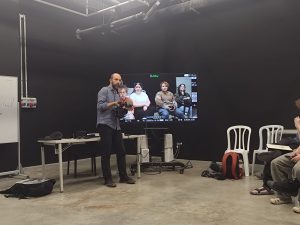
Moments from the film and animation workshop at Bezalel, featuring guest lecturers from Poland Łukasz Konopa and Dr. Katarzyna Taras.

“Fatherland” at the Arava Film Festival 🗓
Andrzej Wajda Month at Cinema Spiegel 🗓