

1. The title of your exhibition is ‘Deep Cuts’. What do these ‘deep cuts’ mean to you – are they purely a physical gesture on canvas or a metaphor for something you have hidden deeper?
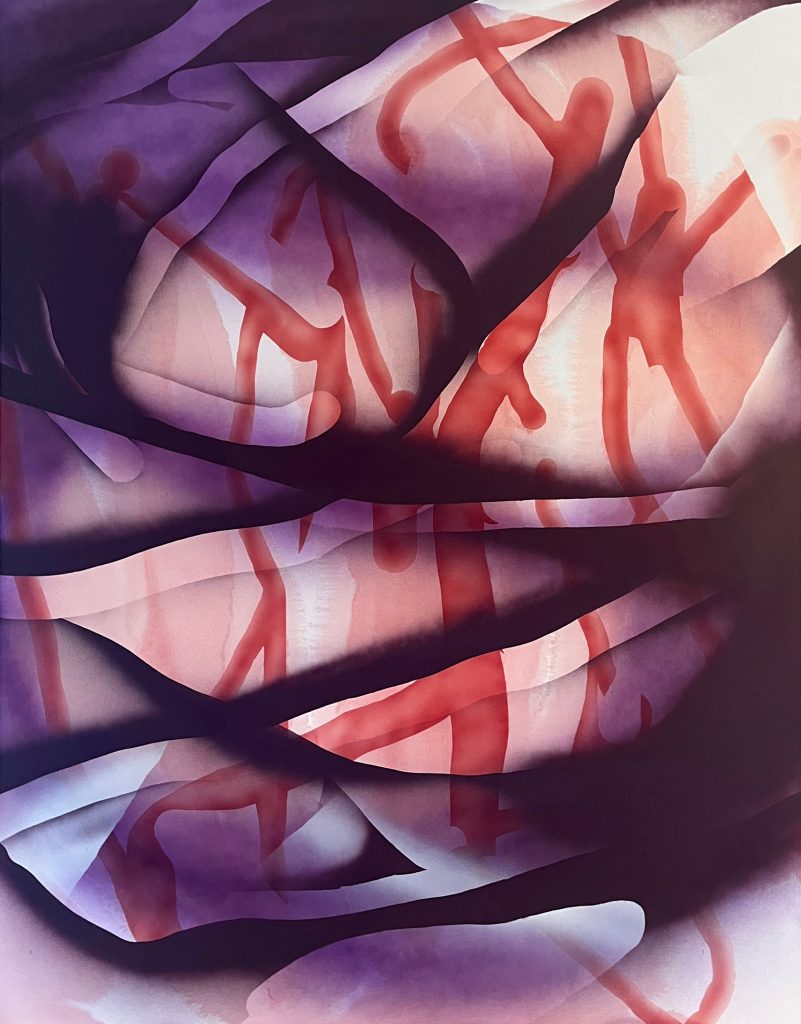
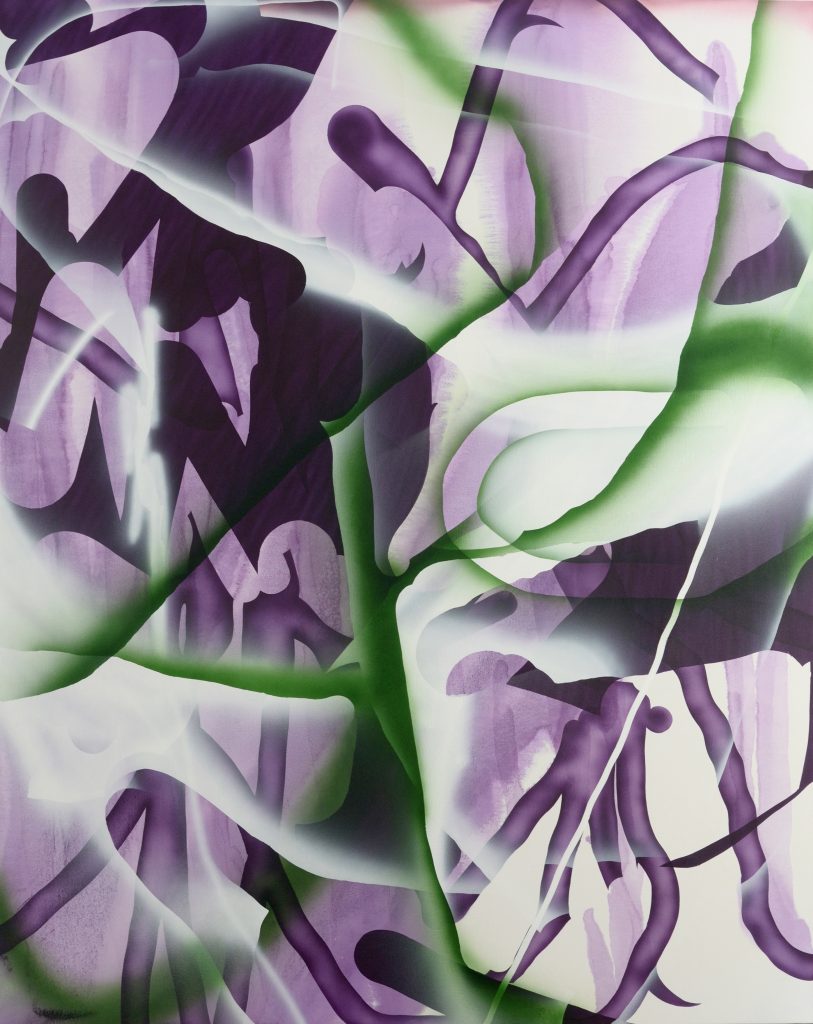
Sebastian Krzywak: I like the ambiguity of these words. On the one hand, it is a slang term for lesser-known pieces of music, but important to those who listen to that music. On the other hand, in the literal translation, it simply means deep cuts – words that evoke rather disturbing associations. This kind of tension can also be associated with my works, which on the one hand can be perceived as visually mesmerizing, but on the other hand are not devoid of expression, of sharp, deep cuts. They can therefore soothe or irritate. Besides, it is a reference to the processual nature of these paintings. While working on this series, I realized that I mainly use an airbrush, spray paint, and poured paint, which means that all the paintings are created in the air, so to speak. The only direct contact with the canvas is cutting out shapes and templates directly into the tape stuck on the painting.
2. In your works, you combine acrylic with spray paint. What does each of these extremely different techniques bring to your painting language?
Sebastian Krzywak: Choosing a technique is simply a matter of finding the best way to realize your ideas. I used to experiment more with other techniques, using various non-standard materials. Nowadays, I mainly use acrylic paints, inks, and sprays, which are fairly traditional techniques.
3. In one interview, you mention a specific loop: you start by designing on the computer, paint on canvas, then photograph the image and return to the virtual world with it. How would you describe the role of this dialogue between the digital and the analog in building the layers of your images?
Sebastian Krzywak: The idea for these images came partly from a series of simple drawings made on the computer using the eraser tool. Once, while browsing through a folder with a collection of such sketches, I decided to see if they could be translated into the language of painting. Currently, I start most of my works with such a drawing on the computer, a kind of framework, core, and reference point for subsequent layers. After transferring it to canvas, I pour paint onto the image and try to direct the process. Each time I have some assumptions, but the process is quite dynamic and requires quick reactions, e.g., regarding color changes, the angle of paint flow, and stopping the action. After this stage, I take a photo and test subsequent versions of the image on the computer. Usually, several to several dozen versions of the finished image are created. I think that this intermingling of working methods has, in fact, blurred the line between the analog and digital worlds after a while.
4. Critics describe the white space in your works as a psychological space. How do you define the role of these empty spaces in the entire process of creating a painting?
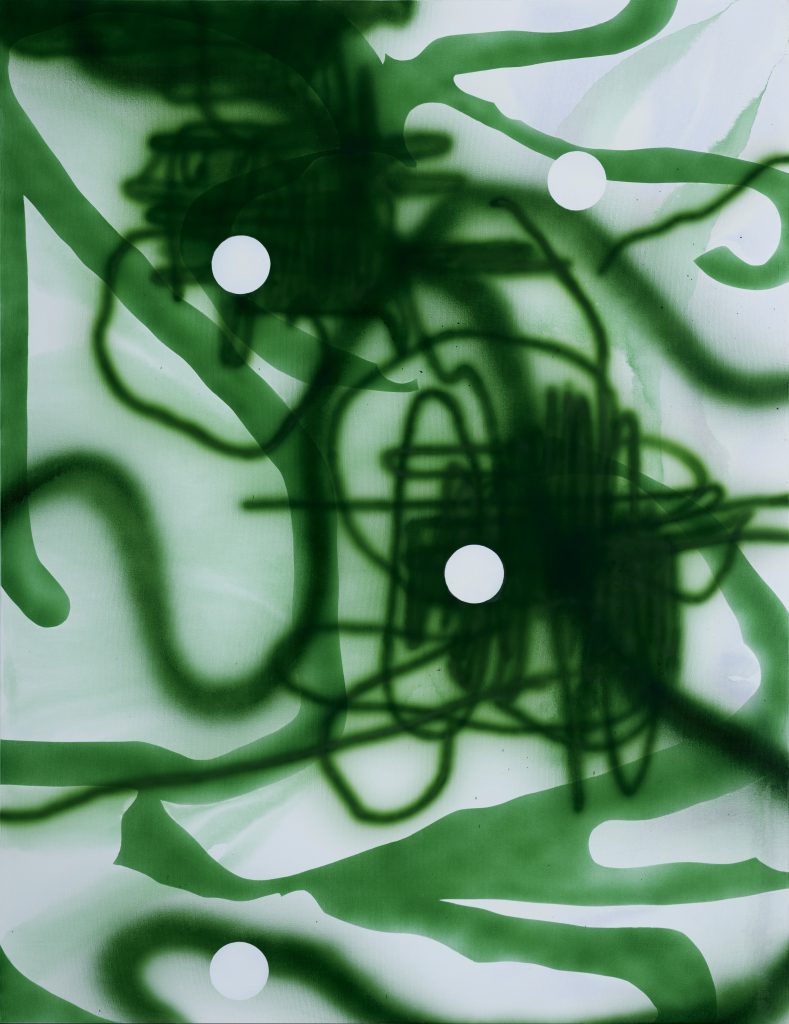
Sebastian Krzywak: There were two reasons for leaving the raw white of the canvas in the painting. They appeared simultaneously, so I don’t know which one is more important. On the one hand, I simply wanted to introduce strong overexposure to the image, a kind of lightness associated with a sheet of paper, with a sketch. I also asked myself about the moment when a painting is finished. On the other hand, it was a time when I probably permanently lost my sense of smell after contracting COVID-19. I quickly and painfully understood what the famous Proust effect is all about. When cut off from certain smells, we lose access to the storehouse of memories that are activated by them. So, in a sense, it is about loss.
5. Your canvases are often 190 cm high and tower over you in size. Given the monumental scale and the titular cuts, how would you describe your role in the process of creating these works – do you feel more like a builder of new space or someone who operates on the living matter of the image?
Sebastian Krzywak: Indeed, my favorite format is 190 x 150 cm, which is 5 cm taller than me and gives me the opportunity to ‘enter the painting’. I think scale is very important in this type of painting. Not every type of painting needs scale, but this type of abstract painting, in my opinion, is strongly related to the psychophysical perception of the image. This difference can be easily compared to watching a movie on your phone, on your computer, and in the cinema. There are movies that simply have to be watched in the cinema. If I had to compare my activity while painting to a profession, I would definitely choose a director, because I am both an observer and an active participant in the process.
6. With such large formats and aggressive techniques, the margin for error is huge. After years of work, do you trust chance enough to treat it as a full-fledged co-author of your paintings?
Sebastian Krzywak: The principle governing the creation of these paintings is the interpenetration of a kind of randomness resulting from gravity and maximum control of planning at other stages. When working with gravity, I lose some control over the final effect of the painting. Some time ago, after Romea Castellucci’s performance of The Four Seasons Restaurant, I read a transcript of a conversation with the director. He talked about the reasons for the presence of dogs in his performances. I think that gravity plays the same role for me as the dog does for Castellucci. I will quote this statement because I think it is worth it:
‘An animal on stage represents a simple, ordinary life. By showing a dog, I break the fiction. And the dog, which captures the audience’s attention, becomes the master of ceremonies. I often begin sequences in my performances with a dog. In this case, I am not referring to language, but to the body of theater. The animal does not represent any symbols, it comes from another world and respects only the laws of nature. The dog’s movements are unpredictable. By bringing a dog on stage, I take a risk because I know that anything can happen. Above all, it is about the balance between order and disorder, between having control and letting go of it. I need this combination immensely. Beauty takes on a different dimension here. Introducing an animal onto the stage means being open to new structures resulting from chance…[1]’.
7. The exhibition at the Platán Gallery brings the results of your personal work from the privacy of your studio into the public space. How do you perceive this change – from the moment you make the physical gesture of cutting the canvas to the moment it becomes part of a stranger’s experience?
Sebastian Krzywak: The exhibition presents a cross-section of paintings created between 2023 and 2025. The selection was made by its curator, Tomasz Piars. Some of the works have been shown before, but at separate exhibitions, and some will be shown for the first time. I am very excited about this exhibition.
Interview conducted by: Wiktor I. Michałowski
[1] The Four Seasons Restaurant, czyli Castellucci na Malcie, Aleksandra Hołownia, o.pl magazine, 03.07.2013
Dystopian Reflections exhibition at Brody House 🗓