

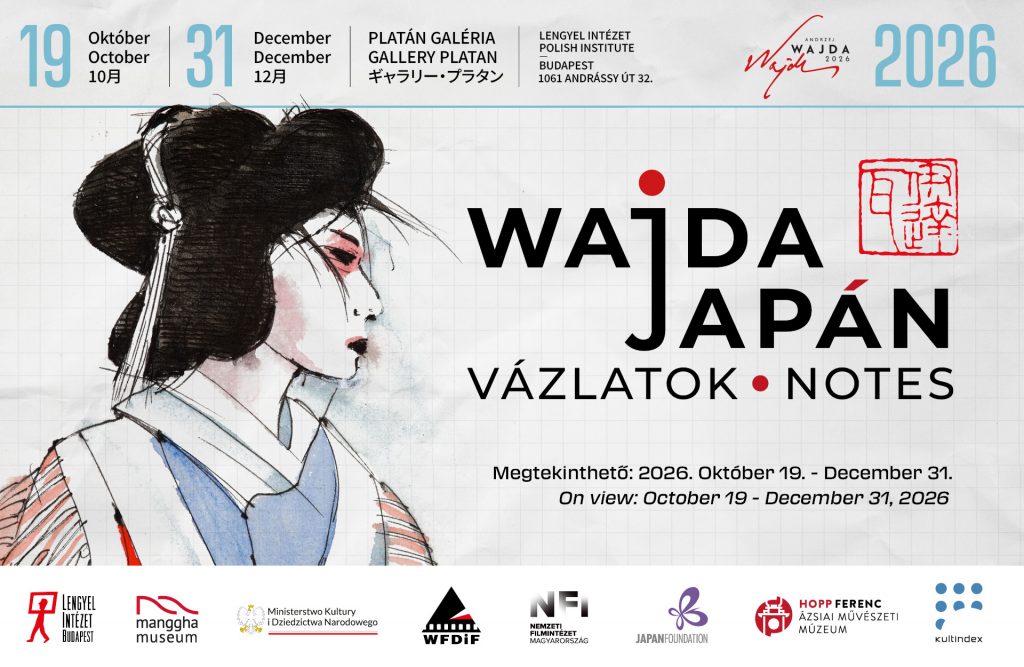
“Wajda / Japan / Sketches” at Gallery Platan
The title of the exhibition is formed at the point where three words intersect. The same triad also structures the exhibition itself: Andrzej Wajda, his personal and artistic discovery of Japan, and his sketches as a mode of seeing, remembering and creating. The exhibition pays tribute to Andrzej Wajda (1926–2016), the Honorary Academy Award-winning Polish film and theatre director, on the centenary of his birth. Wajda’s name is familiar in Hungary, yet his oeuvre is no longer an immediately self-evident point of reference. His filmography — including Ashes and Diamonds, Man of Marble, Man of Iron and Katyń — could in itself form the subject of a major exhibition, as could his work as a theatre director.
This exhibition, however, is not primarily about Wajda the film director. It presents another, less familiar figure: the draughtsman trained in the visual arts, the traveller, the mediator of Japanese culture, and the man who devoted several decades of his life to an exceptionally noble cause. Wajda first encountered Japan through art in Kraków in 1944, at the age of eighteen, when, under the Nazi German occupation of the city, he saw an exhibition of Japanese works from the collection of Feliks “Manggha” Jasieński. The world of Japanese woodblock prints — the visual thinking of Hokusai, Hiroshige, Utamaro and other masters — left a lifelong impression on him. Wajda only reached Japan for the first time in 1970. He later returned six more times, usually together with his wife, Krystyna Zachwatowicz-Wajda. During these journeys, Japan became for him not a distant attraction, but a gradually personal place: a network of gardens, temples, theatrical experiences, urban details, friendships and impressions fixed in drawings. In 1987, he received the prestigious Kyoto Prize of the Inamori Foundation and donated the entire prize money to the establishment of a Japanese art centre in Kraków. As a result, the Manggha Museum of Japanese Art and Technology — a permanent display opportunity for the invaluable Japanese art collection of Feliks “Manggha” Jasieński — opened in 1994.
The major focus of the exhibition places Wajda as a draughtsman at the centre. The works made during his Japanese journeys are small-scale drawings on paper, often preserved on lined or squared notebook pages and in sketchbooks. Their techniques are deliberately modest and portable: pen, pencil, coloured pencil, felt-tip pen, black chalk, and, in some cases, watercolour or other tools suitable for use while travelling. These sheets are not representative works made under studio conditions, but visual notes created on the move and through observation on site. Their small scale, portability, and fragmentary character emphasise the process of drawing itself: Wajda does not create large compositions but records visual thoughts.
In interpreting the Japanese sketches, it is particularly important to recognise that they bring together several kinds of gaze. On the one hand, they reveal Wajda the director: drawing functions as a tool of framing, spatial organisation, and theatrical and cinematic thinking. This includes sheets that evoke Japanese theatrical forms, performance situations, stage movements, or the network of connections that emerged between Wajda and the Japanese film and theatre worlds. On the other hand, they show Wajda the traveller: the drawings are impressions recorded on site, quick reminders, and visual notes on a culture that was initially unfamiliar to him but gradually became personal. Thirdly, they reveal Wajda the visual artist: in those textless drawings that do not explain but seek the aesthetic density of what is seen – the expressive force of line, empty surface, proportion, rhythm, and framing.
The exhibition’s image of Japan is built from this threefold perspective. In Wajda’s drawings, Japan does not appear as an encyclopaedic or touristic totality, but as a sequence of details, motifs, and visual situations. Temples, gardens, urban spaces, theatrical experiences, figures, and everyday scenes become visible through the filter of artistic attention. The drawings often reveal compositional principles familiar from Japanese woodblock prints: asymmetry, the highlighting of detail, bold cropping, planarity, and simplified form. The aim of the exhibition, however, is not to interpret Wajda’s drawings as imitations of Japanese works, but to show that these sheets are active, interpretive responses by a European artist to Japanese visual culture. (Mirjam Dénes curator)
The exhibition is organised in collaboration with:
Manggha Museum of Japanese Art and Technology Kraków, MKiDN (Ministry of Culture and National Heritage of the Republic of Poland), WFDiF (Documentary and Feature Film Studio in Poland), Nemzeti Filmintézet – Filmarchívum (National Film Institute Hungary – Film Archive), Dr. DÉNES Lukács, Kultindex Nonprofi t Kft., Japán Alapítvány (Japan Foundation), Hopp Ferenc Ázsiai Muvészeti Múzeum (Ferenc Hopp Museum of Asiatic Arts)
On view till December 31, 2026.